A short-acting local anaesthetic
Chloroprocaine
A short-acting local anaesthetic used to numb an area for procedures, given by professionals.
What is Chloroprocaine?
Chloroprocaine is a short-acting local anaesthetic, a medicine that numbs part of the body so a procedure can be done without pain. It is used for spinal and other regional anaesthesia and in dental work, and is chosen when a quick onset and short duration suit the procedure. It is always given by trained professionals, because injecting a local anaesthetic into the wrong place, or too much, can cause serious effects on the heart and nervous system (local-anaesthetic toxicity). It wears off relatively quickly, which is often an advantage for shorter procedures.
Education and reference only. This is a plain-language guide to Chloroprocaine — it deliberately contains no doses. Doses depend on the person, the brand and the reason for treatment, and belong with your prescriber. Always check the BNF, the product labelling (SmPC) and follow medical advice.
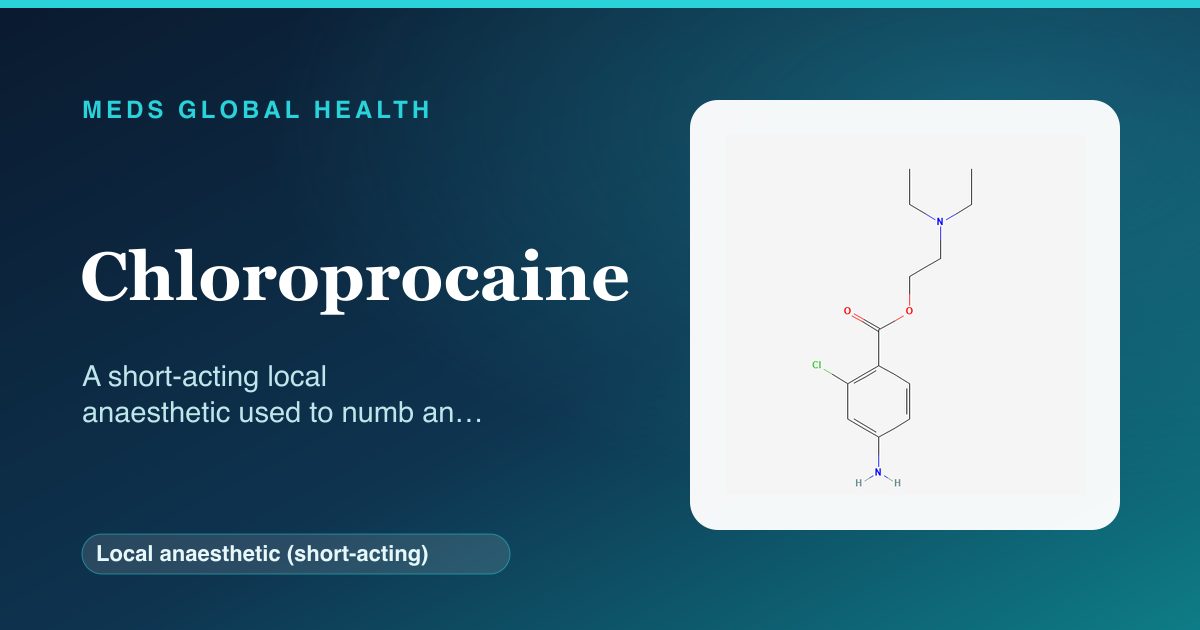
What it is
Chloroprocaine is a local anaesthetic, a medicine that temporarily blocks pain in the part of the body where it is injected. It is short-acting, meaning it works quickly and wears off relatively soon, which makes it useful for shorter procedures. It is used for spinal anaesthesia and other types of regional anaesthesia, and in dentistry. It is not something people take themselves; it is given by anaesthetists, surgeons or dentists who are trained to use it and to manage anaesthesia safely.
How it works
Chloroprocaine blocks the nerves in the area where it is injected from sending pain signals, so that part of the body becomes numb for a while. Depending on where it is placed, it can numb a small area, a region, or, with a spinal injection, the lower part of the body. Because it is short-acting, the numbness comes on quickly and then fades within a relatively short time, which is convenient for procedures that do not take long and where a fast recovery of sensation and movement is helpful.
Company & origin
A short-acting local anaesthetic used by professionals for spinal and regional anaesthesia and in dentistry.
Practical use
How to take Chloroprocaine
General, dose-free guidance — always follow your prescriber's and the leaflet's specific instructions.
- It is given by a trained professional such as an anaesthetist, surgeon or dentist, not used by yourself.
- Tell the team beforehand about any allergies, especially to local anaesthetics, and any heart or nerve conditions.
- Report straight away any dizziness, ringing in the ears, numbness around the mouth, a metallic taste or odd feelings during the procedure.
- After spinal or regional use, follow advice on moving carefully until full feeling and movement return.
- Arrange any support you are advised to have for getting home and recovering after the procedure.
Weighing it up
Advantages & disadvantages of Chloroprocaine
Advantages
- Numbs the area quickly so procedures can be done without pain.
- Short-acting, which allows a quicker return of feeling and movement after shorter procedures.
- Useful for spinal and regional anaesthesia and in dentistry, given by trained professionals.
Disadvantages
- Must be given by trained professionals, as wrong placement or too much can cause serious toxicity.
- Its short duration means it is not suited to longer procedures on its own.
- Like all local anaesthetics, it can rarely cause serious effects on the heart and nervous system.
Practical use
Good to know
The most important point with chloroprocaine is that it is given by trained professionals in a controlled setting, because local anaesthetics can be dangerous if they reach the bloodstream in large amounts or are injected in the wrong place. This is called local-anaesthetic systemic toxicity and can affect the nervous system (causing things like dizziness, ringing in the ears, a metallic taste, numbness around the mouth and, in severe cases, fits) and the heart. The team giving it is trained to prevent, recognise and treat this, which is why dose and placement are carefully controlled. Its short duration is often an advantage, allowing a quicker return of feeling and movement after shorter procedures. Tell the team about allergies and any heart or nerve conditions before the procedure.
Who should not take it / use with caution
- People who have had a serious allergic reaction to chloroprocaine or similar local anaesthetics should not be given it.
- It is used with caution, and the approach adjusted, in people with certain heart or nervous-system conditions.
- It is only given by trained professionals able to monitor for and treat local-anaesthetic toxicity.
Monitoring
- Close monitoring of blood pressure, heart rate and breathing during and after the procedure.
- Watching for early signs of local-anaesthetic toxicity.
- Checking that feeling and movement return as expected afterwards.
Side effects
- Numbness and loss of movement in the treated area while it is working, which then wears off.
- Low blood pressure, slow heart rate or headache, particularly after spinal use.
- Rarely, serious local-anaesthetic toxicity affecting the nervous system or heart, which the team is trained to treat.
Key interactions
- Tell the team about all your medicines, including any that affect the heart rhythm or other local anaesthetics.
- Its effects can add to those of other local anaesthetics, so total amounts are carefully controlled.
- Certain medicines and conditions can change how the body handles it, which the professional takes into account.
Available as: A solution for injection, given for spinal, regional or dental anaesthesia by a professional.
Answers
Chloroprocaine: frequently asked questions
What is chloroprocaine used for?
It is a short-acting local anaesthetic used to numb part of the body for procedures, including spinal and regional anaesthesia and dental work.
Why is it only given by professionals?
Local anaesthetics can be dangerous if too much reaches the bloodstream or they are injected in the wrong place, so they are given by trained staff who can monitor and treat any problems.
Why is its short action useful?
Because it wears off relatively quickly, feeling and movement return sooner, which suits shorter procedures and a faster recovery.
What should I report during the procedure?
Tell the team straight away about dizziness, ringing in the ears, a metallic taste, numbness around the mouth or any odd feelings, as these can be early warning signs.
Will I be able to move afterwards?
After spinal or regional use, feeling and movement return as the anaesthetic wears off; follow the team's advice on moving carefully until they do.
The wider class
About Local anaesthetic (short-acting)
Chloroprocaine belongs to the local anaesthetic (short-acting) class. For how the class as a whole works, its shared safety principles and monitoring, see the full guide.
Browse by body system
Authoritative sources
- BNF
- NICE CKS
Building a medicines information resource?
We create evidence-led, dose-free drug and formulary references for teams.