An ester local anaesthetic, also known as Novocain
Procaine
An older ester local anaesthetic, also known as Novocain, used by injection to numb an area, now largely superseded.
What is Procaine?
Procaine, also known by the old brand name Novocain, is a local anaesthetic from the 'ester' group. It is given by injection or infiltration to numb a particular area of the body so a procedure can be carried out without pain. It works by temporarily blocking the nerves in that area from sending pain signals. It has largely been superseded by newer local anaesthetics. Its main concerns are systemic toxicity if too much enters the bloodstream or it is mis-injected, and allergy, which is linked to a breakdown product called PABA.
Education and reference only. This is a plain-language guide to Procaine — it deliberately contains no doses. Doses depend on the person, the brand and the reason for treatment, and belong with your prescriber. Always check the BNF, the product labelling (SmPC) and follow medical advice.
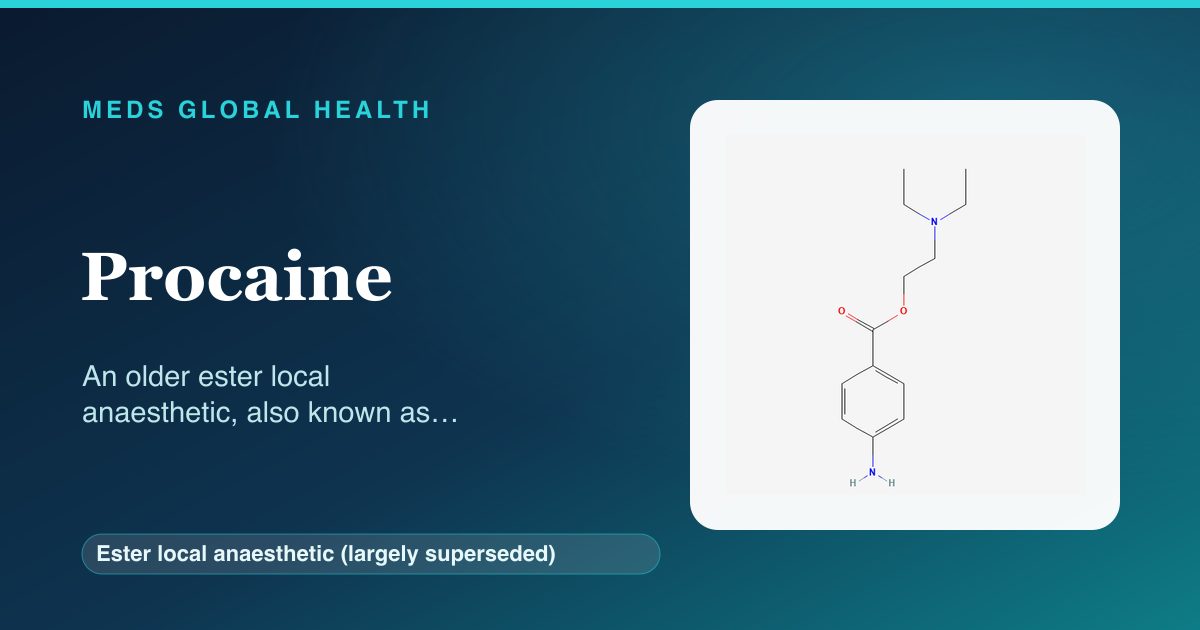
What it is
Procaine is one of the original local anaesthetics, belonging to the 'ester' chemical group, and is widely known by its old brand name Novocain. It is given by injection into or around the area to be numbed (infiltration), blocking sensation there so a procedure can be done painlessly. Although historically very important, it has largely been replaced by newer local anaesthetics such as lidocaine, which tend to last longer, work more reliably and cause fewer allergic reactions. It is used by trained healthcare professionals.
How it works
Procaine works by temporarily blocking the tiny channels that nerves use to send electrical signals. When injected into an area, it stops the local nerves from transmitting pain signals to the brain, so that area becomes numb for a while. As the medicine is broken down and cleared, the nerves recover and feeling returns. Because it is an 'ester' anaesthetic, it is broken down in the blood into substances including one called PABA, which is the part linked to the allergic reactions some people have to this group of anaesthetics.
Company & origin
An older 'ester' type of local anaesthetic, also known as Novocain, used for injection and infiltration to numb an area; now largely superseded by newer local anaesthetics.
Practical use
How to take Procaine
General, dose-free guidance — always follow your prescriber's and the leaflet's specific instructions.
- It is given by a trained healthcare professional as an injection to numb a specific area.
- Tell the professional about any previous allergy or reaction to local anaesthetics before it is used.
- Report tingling around the mouth, ringing in the ears, dizziness, a metallic taste or feeling unwell during or after the injection.
- Take care of the numb area until normal feeling returns, to avoid accidental injury.
- Mention any heart, liver or nerve conditions, as these can affect how it is used.
Weighing it up
Advantages & disadvantages of Procaine
Advantages
- Numbs a specific area so a procedure can be done without pain.
- A long-established medicine and one of the original local anaesthetics.
- Acts locally, so it generally avoids the effects of putting someone fully to sleep.
Disadvantages
- Can cause systemic toxicity if too much enters the bloodstream or it is mis-injected.
- More likely than newer anaesthetics to cause allergic reactions, linked to its PABA breakdown product.
- Largely superseded by newer local anaesthetics that last longer and work more reliably.
Practical use
Good to know
Two safety points stand out with procaine. First, like all local anaesthetics, it can cause systemic toxicity if too much reaches the bloodstream, for example if a large amount is used or it is accidentally injected into a blood vessel; this can affect the brain (causing tingling around the mouth, ringing in the ears, confusion or fits) and the heart, which is why dosing and careful injection technique matter and why it is given by trained staff. Second, as an ester anaesthetic broken down to PABA, it is more likely than newer anaesthetics to cause allergic reactions, so a history of allergy to local anaesthetics is important to mention. These factors, together with its relatively short action, are why it has largely been superseded by newer agents.
Who should not take it / use with caution
- People who have had an allergic reaction to procaine or other ester local anaesthetics should not be given it.
- It is used with caution in people with certain heart or nerve conditions.
- It is given with care, at controlled amounts, by trained professionals to avoid toxicity.
Monitoring
- Watching for any allergic reaction during and after the injection.
- Watching for signs of systemic toxicity, particularly when larger amounts are used.
- Checking that feeling returns to the area normally afterwards.
Side effects
- Allergic reactions, which are more common with ester anaesthetics like this one.
- Signs of systemic toxicity if too much reaches the bloodstream, such as tingling around the mouth, ringing in the ears, dizziness, confusion or fits.
- Effects on the heart, such as a slow or irregular heartbeat or low blood pressure, in toxicity.
Key interactions
- It can interact with certain other medicines, including some that affect the heart.
- It may interact with sulfonamide antibiotics through its PABA breakdown product.
- The professional will consider all your medicines and conditions before using it.
Available as: A solution for injection, given by a healthcare professional.
Answers
Procaine: frequently asked questions
What is procaine used for?
It is a local anaesthetic given by injection to numb a particular area of the body so a procedure can be carried out without pain.
Is procaine the same as Novocain?
Yes. Novocain is the old brand name for procaine; they are the same medicine, one of the original local anaesthetics.
Why has it largely been replaced?
Newer local anaesthetics such as lidocaine tend to last longer, work more reliably and cause fewer allergic reactions, so procaine is now used much less.
Why can it cause allergic reactions?
As an 'ester' anaesthetic it is broken down into a substance called PABA, which is linked to the allergic reactions some people have to this group of anaesthetics.
What is systemic toxicity?
It is when too much anaesthetic reaches the bloodstream and affects the brain and heart, causing symptoms like tingling, ringing in the ears, confusion or heart-rhythm changes.
The wider class
About Ester local anaesthetic (largely superseded)
Procaine belongs to the ester local anaesthetic (largely superseded) class. For how the class as a whole works, its shared safety principles and monitoring, see the full guide.
Browse by body system
Authoritative sources
- BNF
- NICE CKS
Building a medicines information resource?
We create evidence-led, dose-free drug and formulary references for teams.