A numbing ingredient in throat lozenges and sprays
Dyclonine
A topical local anaesthetic used in lozenges and sprays to numb and soothe a sore mouth or throat.
What is Dyclonine?
Dyclonine is a topical local anaesthetic, a numbing ingredient found in some throat lozenges and sprays used to ease the discomfort of a sore mouth or throat. It works on contact by temporarily numbing the surface so pain is dulled. Because it numbs the throat, care is needed with eating and drinking soon after using it, as it can be harder to feel hot food or to swallow safely. The main concern is a local allergic reaction. It eases symptoms rather than treating the cause of a sore throat.
Education and reference only. This is a plain-language guide to Dyclonine — it deliberately contains no doses. Doses depend on the person, the brand and the reason for treatment, and belong with your prescriber. Always check the BNF, the product labelling (SmPC) and follow medical advice.
What it is
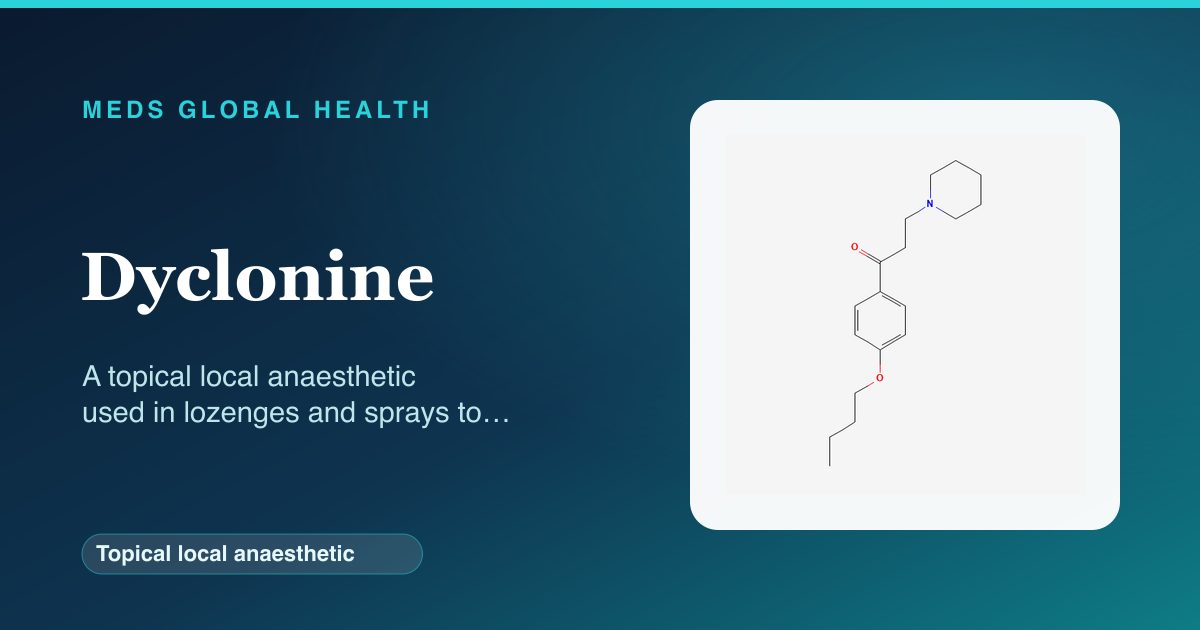
Dyclonine is a local anaesthetic that numbs the surface it touches. It is used in some throat lozenges and sprays to relieve the soreness of a painful mouth or throat, for example with a cold or minor throat irritation. Rather than being swallowed to work inside the body, it acts on the lining of the mouth and throat where it is applied, dulling pain for a short time. It is a symptom-relieving product, soothing discomfort while the underlying cause settles on its own or is treated separately.
How it works
Dyclonine works by temporarily blocking the nerve signals that carry pain from the surface of the mouth and throat. When a lozenge dissolves or a spray is used, it numbs the lining it touches, so the raw, sore feeling is dulled for a while. Because it acts only where it is applied and only for a short time, it gives local relief without working throughout the body. As the effect wears off, normal feeling returns, which is why it is used as needed for comfort rather than as a cure.
Company & origin
A numbing ingredient used in some throat lozenges and sprays to ease the pain of a sore mouth or throat.
Practical use
How to take Dyclonine
General, dose-free guidance — always follow your prescriber's and the leaflet's specific instructions.
- Use the lozenge or spray as directed on the product, letting a lozenge dissolve slowly in the mouth.
- Take care with eating and drinking for a short while afterwards, as your throat will be numb and it is harder to feel hot food or swallow safely.
- Avoid very hot drinks or food straight after use until normal feeling returns.
- Stop using it and seek advice if your mouth or throat becomes more irritated or swollen after use.
- See a healthcare professional if a sore throat is severe, lasts more than a few days, or comes with a high temperature or trouble swallowing or breathing.
Weighing it up
Advantages & disadvantages of Dyclonine
Advantages
- Eases the pain of a sore mouth or throat by numbing the surface on contact.
- Convenient to use as a lozenge or spray, applied where it is needed.
- Acts mainly where it is applied, so it works locally for short-term relief.
Disadvantages
- Numbs the throat, so care is needed with hot food, drink and swallowing for a short while afterwards.
- Can cause local stinging, irritation or an allergic reaction.
- Relieves symptoms rather than treating the cause of a sore throat.
Practical use
Good to know
The most useful thing to know is that dyclonine numbs the throat, so for a short time after using it, it can be harder to feel hot drinks or food and to swallow safely. It is sensible to avoid very hot food or drink straight afterwards and to take care when eating until normal feeling returns, so you do not burn or choke without noticing. The main side effect is a local reaction such as stinging, irritation or, occasionally, an allergic reaction in the mouth or throat. It relieves the soreness rather than treating the cause, so a sore throat that is severe, lasts more than a few days, or comes with a high temperature or difficulty swallowing or breathing should be checked by a healthcare professional.
Who should not take it / use with caution
- People who have had an allergic reaction to dyclonine or similar numbing ingredients should not use it.
- It is used with care in young children, who may not manage a numb throat safely; follow the product advice on age.
- Anyone with a severe sore throat, trouble swallowing or breathing, or a high temperature should seek medical advice rather than relying on it.
Monitoring
- No routine blood or other tests are needed for this kind of soothing product.
- Watching for any local allergic reaction such as swelling or rash.
- Reviewing whether a sore throat is settling, and seeking advice if it is severe or lasting.
Side effects
- Temporary numbness of the mouth and throat where it is applied.
- Local stinging or irritation in some people.
- Occasionally, a local allergic reaction such as swelling, rash or itching, which should prompt stopping and seeking advice.
Key interactions
- It has few important interactions with other medicines because it acts mainly on the surface where it is applied.
- Avoid using more than one numbing throat product at the same time unless advised, to limit the numbing effect.
- Tell a pharmacist about other lozenges or throat sprays you use, to avoid doubling up.
Available as: Lozenges and sprays for the mouth and throat.
Answers
Dyclonine: frequently asked questions
What is dyclonine used for?
It is a numbing ingredient in some throat lozenges and sprays, used to ease the pain of a sore mouth or throat.
Why do I need to be careful eating after using it?
It numbs the throat, so for a short time it is harder to feel hot food and to swallow safely; avoid very hot food or drink until feeling returns.
Does it cure a sore throat?
No. It relieves the soreness for a while but does not treat the cause, so a severe or lasting sore throat should be checked.
Can it cause an allergic reaction?
Occasionally it can cause a local allergic reaction such as swelling or a rash; stop using it and seek advice if this happens.
When should I see a healthcare professional?
See someone if a sore throat is severe, lasts more than a few days, or comes with a high temperature or difficulty swallowing or breathing.
The wider class
About Topical local anaesthetic
Dyclonine belongs to the topical local anaesthetic class. For how the class as a whole works, its shared safety principles and monitoring, see the full guide.
Browse by body system
Authoritative sources
- BNF
- NICE CKS
Building a medicines information resource?
We create evidence-led, dose-free drug and formulary references for teams.