A local anaesthetic used mainly in dentistry and regional blocks
Mepivacaine
A local anaesthetic used mainly in dentistry and for regional nerve blocks, given by trained professionals to numb a part of the body.
What is Mepivacaine?
Mepivacaine is a local anaesthetic, a medicine that numbs a specific part of the body so a procedure can be carried out without pain. It is used mainly in dentistry and for regional nerve blocks. It is given by injection by a trained professional such as a dentist or anaesthetist, not taken by the patient. Its effects are usually local, such as numbness and tingling that wear off as it leaves the area. Rarely, if too much enters the bloodstream, it can cause more serious effects on the heart and nervous system, which is why it is given by trained staff who calculate the amount carefully.
Education and reference only. This is a plain-language guide to Mepivacaine — it deliberately contains no doses. Doses depend on the person, the brand and the reason for treatment, and belong with your prescriber. Always check the BNF, the product labelling (SmPC) and follow medical advice.
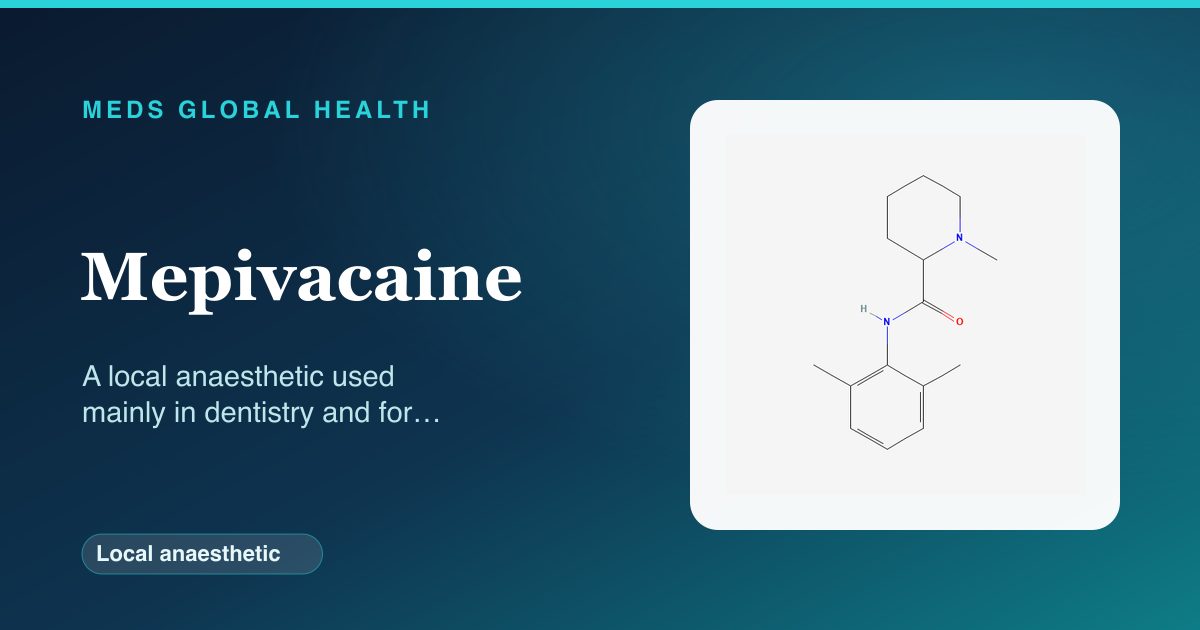
What it is
Mepivacaine is a local anaesthetic, meaning it blocks pain in just the area where it is given rather than putting the whole person to sleep. It is used mostly in dentistry, to numb the mouth before dental work, and for regional nerve blocks, where it numbs a larger area for a procedure. It is given by injection by a trained professional, such as a dentist or anaesthetist, who places it close to the nerves serving the area to be numbed. It is not a medicine that patients take themselves; it is administered as part of a procedure.
How it works
Nerves carry pain signals by passing tiny electrical messages along their length. Mepivacaine works by temporarily blocking the channels that allow these electrical signals to travel, so the nerves in the area cannot send pain messages to the brain. This produces numbness in the part of the body the medicine reaches, allowing a procedure to be done without pain. Because it is placed in one area, the effect is local and temporary, wearing off as the medicine is gradually carried away and broken down by the body, after which normal feeling returns.
Company & origin
A local anaesthetic used in the UK mainly in dentistry and for regional nerve blocks, given by trained professionals.
Practical use
How to take Mepivacaine
General, dose-free guidance — always follow your prescriber's and the leaflet's specific instructions.
- It is given by injection by a trained professional, such as a dentist or anaesthetist, not taken by you.
- While the area is numb, avoid biting your lip, cheek or tongue and avoid very hot food or drink.
- Tell the professional about your medical history, allergies and all your medicines before the procedure.
- Report any unusual symptoms during the procedure, such as a metallic taste, ringing in the ears or dizziness.
- Wait for the numbness to wear off fully before eating, as advised, to avoid accidental injury.
Weighing it up
Advantages & disadvantages of Mepivacaine
Advantages
- Numbs a specific area so procedures, especially dental work, can be done without pain.
- Avoids the need for general anaesthesia for many procedures.
- Has a well-established role in dentistry and regional nerve blocks.
Disadvantages
- Given by injection by a professional, so it is not something patients use themselves.
- Numbness can lead to accidental biting or burns if care is not taken while it lasts.
- Rarely, if too much reaches the bloodstream, it can affect the heart and nervous system.
Practical use
Good to know
Mepivacaine is given by a trained professional during a procedure, so most of what you notice is the numbness it produces and the tingling or odd feeling as it wears off. While the numbness lasts, take care not to bite your lip, cheek or tongue, or to eat very hot food, as you may not feel pain or heat properly. The main safety concern is rare: if too much of the medicine reaches the bloodstream at once, it can affect the heart and nervous system, causing symptoms such as a metallic taste, ringing in the ears, dizziness or, rarely, more serious effects. This is why the professional giving it calculates the amount carefully and watches you during and after. Tell them about your medical history, any allergies and all your medicines beforehand.
Who should not take it / use with caution
- People who have had a serious allergic reaction to mepivacaine or similar local anaesthetics should not be given it.
- It is used with care in people with certain heart problems or serious liver disease, who may need a different approach.
- It is used with care in pregnancy and in young children, with the amount adjusted by the professional giving it.
Monitoring
- The professional watches you during and after the procedure for any reactions.
- Checking that numbness develops and wears off as expected.
- Being alert to rare signs that too much has reached the bloodstream.
Side effects
- Numbness and tingling in the treated area that wears off after the procedure.
- Temporary soreness or bruising where the injection was given.
- Rarely, if too much reaches the bloodstream, a metallic taste, ringing in the ears, dizziness or more serious heart and nervous-system effects.
Key interactions
- It may interact with certain heart-rhythm medicines, so tell the professional what you take.
- Other local anaesthetics given around the same time add to the total amount, which the professional accounts for.
- Tell the team about all your medicines and any history of allergy to anaesthetics.
Available as: A solution for injection, given by a trained professional.
Answers
Mepivacaine: frequently asked questions
What is mepivacaine used for?
It is a local anaesthetic used mainly in dentistry and for regional nerve blocks to numb a specific part of the body so a procedure can be done without pain.
Who gives it?
It is given by injection by a trained professional, such as a dentist or anaesthetist; it is not a medicine you take yourself.
What should I be careful of while numb?
While the area is numb, avoid biting your lip, cheek or tongue and avoid very hot food or drink, as you may not feel pain or heat properly.
Are there serious risks?
Serious effects are rare and happen mainly if too much reaches the bloodstream, which can affect the heart and nervous system; this is why a trained professional calculates the amount carefully.
How long does the numbness last?
The numbness is temporary and wears off as the medicine is carried away and broken down by the body, after which normal feeling returns.
The wider class
About Local anaesthetic
Mepivacaine belongs to the local anaesthetic class. For how the class as a whole works, its shared safety principles and monitoring, see the full guide.
Browse by body system
Authoritative sources
- BNF
- NICE CKS
Building a medicines information resource?
We create evidence-led, dose-free drug and formulary references for teams.