A controlled local anaesthetic used in some specialist surgery
Cocaine
A controlled local anaesthetic, used only in specialist surgery for its numbing and blood-vessel-narrowing effects.
What is Cocaine?
Cocaine has a limited but real medical use as a local anaesthetic, valued because it both numbs an area and strongly narrows blood vessels, which reduces bleeding. In medicine it is used only in some specialist procedures, particularly certain ear, nose and throat or eye operations, applied to the surface of the tissues. It is a controlled drug with strict legal and storage rules and a high potential for misuse, and it can have serious effects on the heart and circulation, including abnormal heart rhythms and raised blood pressure. For these reasons its medical use is confined to specialist settings under careful control. It is never something used at home.
Education and reference only. This is a plain-language guide to Cocaine — it deliberately contains no doses. Doses depend on the person, the brand and the reason for treatment, and belong with your prescriber. Always check the BNF, the product labelling (SmPC) and follow medical advice.
What it is
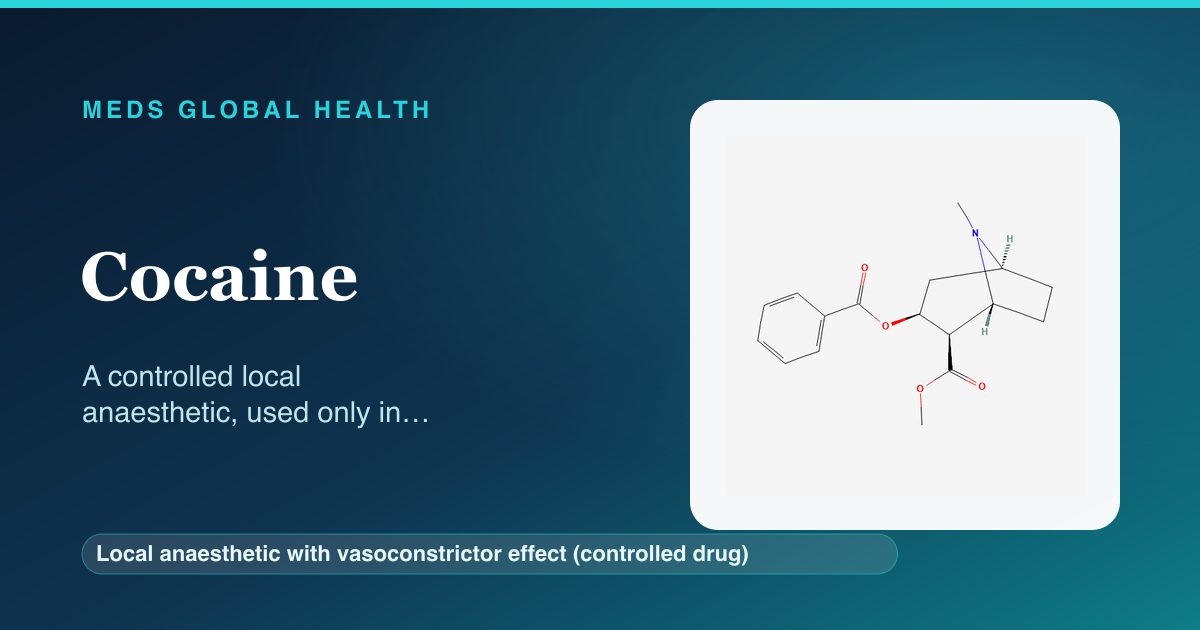
Cocaine is a local anaesthetic, a medicine that numbs tissue, with the unusual added property of strongly narrowing blood vessels in the area it is applied. This combination, numbing plus reduced bleeding, is occasionally useful in certain specialist operations, particularly some procedures on the nose, throat and surrounding areas and some eye procedures, where it is applied to the surface of the tissues. Outside this narrow medical role, cocaine is widely known as a drug of misuse, and in medicine it is tightly controlled. Its use is restricted to specialist settings, with strict rules on prescribing, storage and record-keeping, because of its serious effects and high misuse potential.
How it works
Cocaine works in two ways that make it useful in certain operations. First, like other local anaesthetics, it blocks the nerve signals that carry pain, numbing the area it is applied to. Second, it strongly narrows the small blood vessels in that area, which reduces bleeding and helps the surgeon see clearly. These same actions on the body's nerves and blood vessels, however, are responsible for its dangers: by affecting the circulation and the heart, it can raise blood pressure and trigger abnormal heart rhythms. The very properties that give it a niche surgical use are also what make it a controlled drug with a high potential for harm and misuse.
Company & origin
A local anaesthetic with strong blood-vessel-narrowing effects, used medically only in certain ear, nose and throat or eye procedures under strict controls.
Practical use
How to take Cocaine
General, dose-free guidance — always follow your prescriber's and the leaflet's specific instructions.
- It is used only by specialist teams during specific procedures, applied to the surface of the tissues.
- It is never taken or kept at home; it is a controlled drug used only in the procedure setting.
- Its use is limited to carefully controlled amounts because of its effects on the heart and circulation.
- It is used with monitoring of the heart and blood pressure where appropriate.
- Strict legal rules govern how it is prescribed, stored and recorded.
Weighing it up
Advantages & disadvantages of Cocaine
Advantages
- Both numbs the area and strongly narrows blood vessels, which reduces bleeding during certain procedures.
- Can be useful in some specialist ear, nose, throat or eye operations where these combined effects help.
- Applied to the surface of the tissues for a specific, controlled purpose.
Disadvantages
- A controlled drug with strict legal rules and a high potential for misuse.
- Can cause serious effects on the heart and circulation, including abnormal rhythms and raised blood pressure.
- Use is confined to specialist settings under careful control, with no role outside them.
Practical use
Good to know
The most important things to understand about medical cocaine are that it is a controlled drug and that its main dangers are to the heart and circulation. Even when used correctly in a procedure, it can cause abnormal heart rhythms, a rise in blood pressure and other circulation effects, which is why it is only used in monitored specialist settings and in carefully limited amounts. As a controlled drug, it is subject to strict legal requirements for prescribing, storage and record-keeping, and it carries a high potential for misuse, which is another reason its medical use is so tightly restricted. It is applied to the surface of tissues during specific procedures and is never a treatment people take or keep at home. Any medical use is the decision of a specialist team within a controlled environment.
Who should not take it / use with caution
- People who have had a serious allergic reaction to cocaine should not be given it.
- It is avoided or used with great caution in people with heart disease, abnormal heart rhythms or high blood pressure.
- It is used only within strict specialist control and never for self-treatment or at home.
Monitoring
- Monitoring of the heart and blood pressure during procedures where appropriate.
- Strict record-keeping and control as required for a controlled drug.
- Careful limiting of the amount used to reduce the risk of serious effects.
Side effects
- Abnormal heart rhythms and effects on the heart.
- Raised blood pressure and other effects on the circulation.
- Restlessness, agitation or other effects on the nervous system.
- Local effects where it is applied, such as irritation of the lining of the nose.
Key interactions
- It can interact dangerously with medicines and substances that affect the heart and blood pressure.
- Combining it with other things that stimulate the circulation can increase the risk of serious heart effects.
- Its use alongside other local anaesthetics or vasoconstrictors needs specialist control.
Available as: A solution or preparation applied to the surface of tissues during specialist procedures only.
Answers
Cocaine: frequently asked questions
Is cocaine ever used in medicine?
Yes, it has a limited medical use as a local anaesthetic that also narrows blood vessels to reduce bleeding, used only in some specialist ear, nose, throat or eye procedures.
Why is it so tightly controlled?
It is a controlled drug with a high potential for misuse and can cause serious effects on the heart and circulation, so its medical use is confined to specialist settings under strict rules.
What are its main dangers?
Even when used correctly it can cause abnormal heart rhythms, raised blood pressure and other circulation effects, which is why use is limited and monitored.
Could it ever be used at home?
No. Its medical use is restricted to specific procedures carried out by specialist teams; it is never taken or kept at home.
Why does it reduce bleeding?
As well as numbing the area, it strongly narrows the small blood vessels there, which lessens bleeding and is the reason it is occasionally useful in certain operations.
The wider class
About Local anaesthetic with vasoconstrictor effect (controlled drug)
Cocaine belongs to the local anaesthetic with vasoconstrictor effect (controlled drug) class. For how the class as a whole works, its shared safety principles and monitoring, see the full guide.
Browse by body system
Authoritative sources
- BNF
- NICE CKS
Building a medicines information resource?
We create evidence-led, dose-free drug and formulary references for teams.