A sedating (older) antihistamine
Chlorphenamine
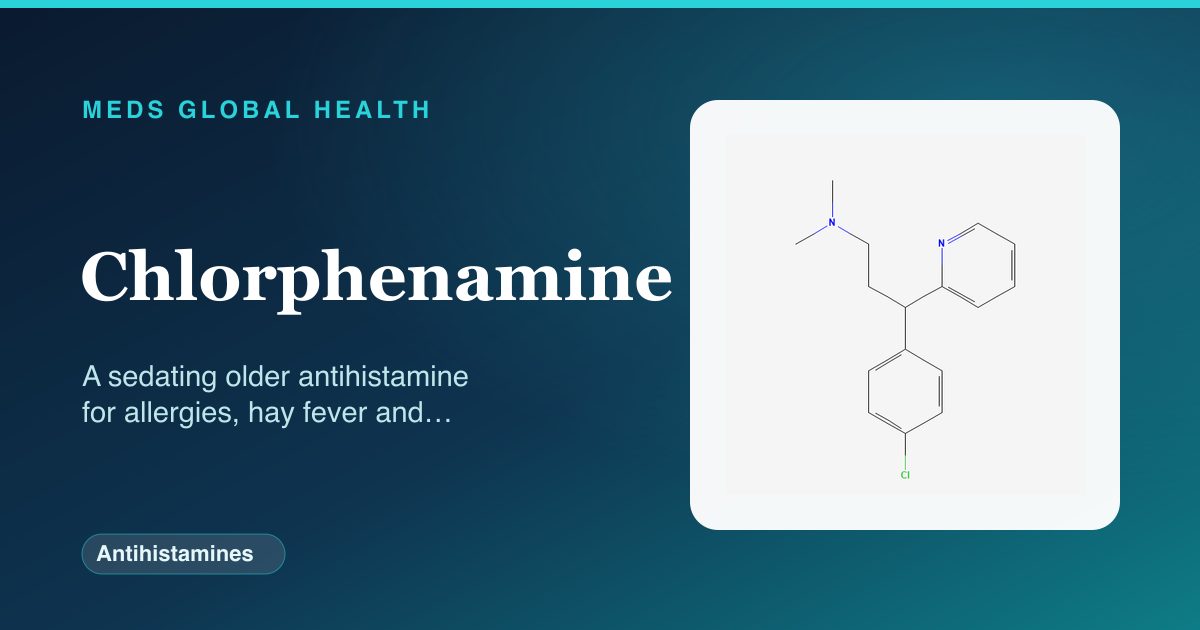
A sedating older antihistamine for allergies, hay fever and itchy rashes, also found in many "all-in-one" cold remedies; it commonly causes drowsiness.
What is Chlorphenamine?
Chlorphenamine is a long-established first-generation antihistamine used to relieve allergy symptoms such as hay fever, itchy skin, hives and reactions to insect bites. It is also used in the emergency treatment of severe allergic reactions.
Education and reference only. This is a plain-language guide to Chlorphenamine — it deliberately contains no doses. Doses depend on the person, the brand and the reason for treatment, and belong with your prescriber. Always check the BNF, the product labelling (SmPC) and follow medical advice.
What it is
Chlorphenamine is a long-established "first-generation" antihistamine used to relieve allergy symptoms such as hay fever (allergic rhinitis), itchy skin, hives (urticaria) and the itching of insect bites. It is also a common ingredient in "all-in-one" cold and flu remedies, where it helps a runny nose and sneezing. Unlike newer antihistamines, it crosses into the brain easily and so tends to cause drowsiness. It has been available for many years and can be bought from pharmacies as well as prescribed. In the UK the best-known brand is Piriton; in the US the same active ingredient (there written "chlorpheniramine") is sold as Chlor-Trimeton.
How it works
Allergic symptoms are largely driven by histamine, a chemical the body releases when it reacts to a trigger such as pollen, dust or an allergen. Histamine acts on H1 receptors to cause itching, sneezing, a runny nose, watery eyes and the swelling and redness of a rash. Chlorphenamine blocks these H1 receptors, so the allergic response is reduced. Because it is an older antihistamine that passes easily into the brain, it also blocks histamine there — which is why it tends to cause drowsiness — and it has some "anticholinergic" (drying) action that can cause a dry mouth.
Company & origin
Originated / developed by: Schering Corporation.
Chlorphenamine (chlorpheniramine) was developed by Schering Corporation in the US, patented around 1948 and introduced into medical use about 1949 as one of the early first-generation antihistamines.
What it treats
Conditions Chlorphenamine is used for
Practical use
How to take Chlorphenamine
General, dose-free guidance — always follow your prescriber's and the leaflet's specific instructions.
- Be aware that chlorphenamine is a sedating antihistamine and very commonly causes drowsiness.
- Do not drive or operate machinery if you feel drowsy, as your reactions may be slowed.
- Avoid alcohol while taking it, as this adds to the sleepiness.
- Take care in older adults, as the sedating and drying effects can be more troublesome.
- If you only need daytime allergy relief, ask your pharmacist about non-drowsy alternatives.
Weighing it up
Advantages & disadvantages of Chlorphenamine
Advantages
- Effective at relieving a wide range of allergy symptoms.
- Long-established and inexpensive, and available from pharmacies.
- Has a useful role in treating severe allergic reactions.
- Its sedating effect can occasionally help at night when itching disturbs sleep.
Disadvantages
- Commonly causes drowsiness, which can affect driving and concentration.
- Can cause a dry mouth, blurred vision and other drying effects.
- Less suitable for older people, who are more sensitive to its side effects.
- Newer non-drowsy antihistamines are often preferred for daytime use.
Practical use
Good to know
Its main practical drawback is drowsiness, so it is best avoided before driving, operating machinery or anything needing full concentration, and it adds to the effect of alcohol. The drowsiness is sometimes used deliberately when itching disturbs sleep at night. It works fairly quickly and is often taken through the day for symptoms, but for ongoing hay fever a newer, non-drowsy antihistamine is usually preferred. A version of chlorphenamine is also used by injection in hospital settings as part of the treatment of severe allergic reactions, alongside other emergency measures. Many cold-and-flu combination products already contain it, so check labels to avoid doubling up.
Who should not take it / use with caution
- Older people are more sensitive to its drowsiness and drying effects, which can add to confusion and falls — so it is generally avoided in frail elderly people.
- Used with caution in people with glaucoma, an enlarged prostate or difficulty passing urine, significant liver disease, and epilepsy, as its drying and sedating effects can cause problems.
- Care in pregnancy and breastfeeding, and it is not suitable for very young children except on specific advice.
Monitoring
- Usually none for short-term use
- Symptom relief and any excess drowsiness
- In older or frail people, any confusion, falls or drying effects
Side effects
- Drowsiness and slowed reactions are common, sometimes lasting into the next day.
- A dry mouth, blurred vision, constipation or difficulty passing urine can occur from its drying (anticholinergic) action.
- Occasionally headache, dizziness or, in children and some older people, the reverse effect of restlessness or excitability.
Key interactions
- Adds strongly to drowsiness with alcohol, sleeping tablets, strong painkillers and other sedating medicines.
- Its drying effects add to those of other "anticholinergic" medicines, increasing dry mouth, constipation and confusion.
- It is already present in many combination cold-and-flu remedies, so taking those together with a separate chlorphenamine can double up the dose unintentionally.
Available as: Tablets and an oral liquid for symptom relief, plus an injection used only in healthcare settings, for example during severe allergic reactions.
Answers
Chlorphenamine: frequently asked questions
Why does chlorphenamine make me so sleepy when other antihistamines don't?
Chlorphenamine is an older antihistamine that passes easily into the brain, where it blocks histamine and causes drowsiness. Newer antihistamines are designed to stay mostly out of the brain, so they relieve allergy symptoms without making most people drowsy. For daytime hay fever, a non-drowsy antihistamine is usually preferred.
Can I drive after taking it?
It is best not to, especially when you first take it, because it can slow your reactions and make you drowsy — sometimes into the next day. Avoid alcohol with it too. If you need allergy relief without drowsiness, ask your pharmacist about a non-sedating antihistamine.
Can I take it with my cold-and-flu remedy?
Check the label first. Many "all-in-one" cold and flu products already contain chlorphenamine, so taking a separate chlorphenamine on top can give you too much. Your pharmacist can help you read the ingredients and avoid doubling up.
Is it safe for older relatives?
It is generally best avoided in frail, older people. Its drowsiness and drying (anticholinergic) effects can add to confusion, dry mouth, constipation and the risk of falls. A newer non-drowsy antihistamine is usually a safer choice — ask the pharmacist.
Is Piriton the same as Chlor-Trimeton?
Yes — both contain the same active ingredient. In the UK it is called chlorphenamine and sold as Piriton; in the US the same ingredient is spelled "chlorpheniramine" and sold as Chlor-Trimeton. The generic active ingredient is identical, just under different names and brands.
The wider class
About Antihistamines
Chlorphenamine belongs to the antihistamines class. For how the class as a whole works, its shared safety principles and monitoring, see the full guide.
Browse by body system
Authoritative sources
- BNF: Chlorphenamine maleate.
- electronic Medicines Compendium (SmPC): Chlorphenamine (Piriton).
- NICE CKS: Chlorphenamine (Piriton).
Building a medicines information resource?
We create evidence-led, dose-free drug and formulary references for teams.