A non-drowsy antihistamine
Fexofenadine
A non-drowsy antihistamine used for hay fever and allergic rhinitis, relieving sneezing, a runny nose, and itchy eyes.
What is Fexofenadine?
Fexofenadine is a non-drowsy, second-generation antihistamine used to relieve the symptoms of hay fever and other allergic rhinitis, such as sneezing, a runny or itchy nose, and itchy eyes. It is also used for some persistent itchy skin conditions.
Education and reference only. This is a plain-language guide to Fexofenadine — it deliberately contains no doses. Doses depend on the person, the brand and the reason for treatment, and belong with your prescriber. Always check the BNF, the product labelling (SmPC) and follow medical advice.
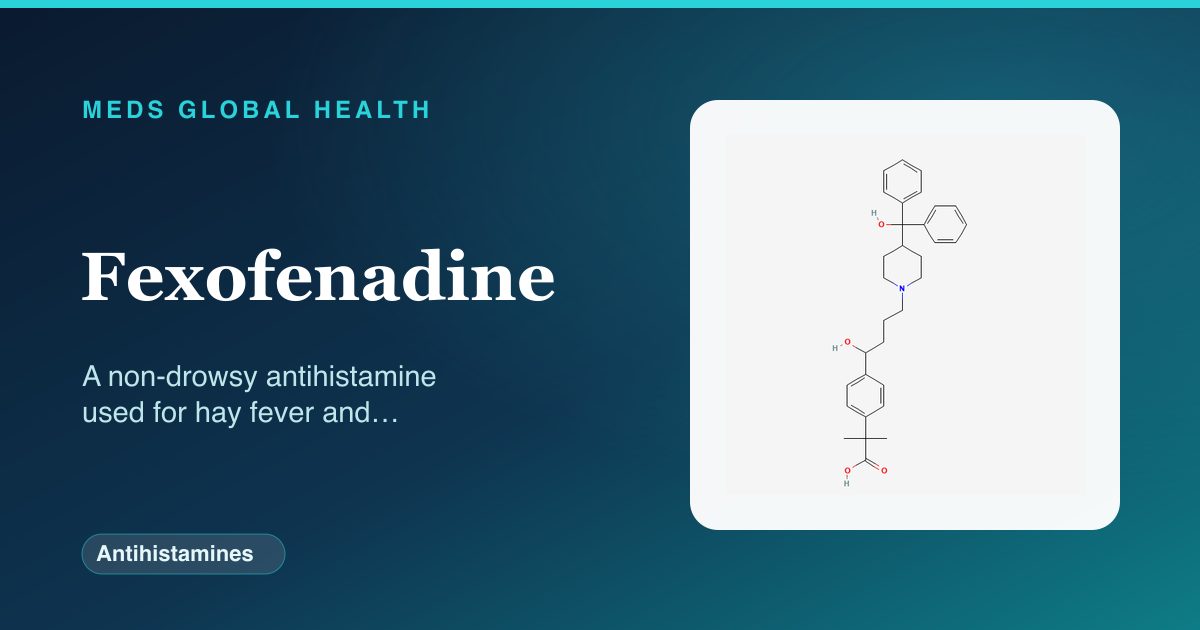
What it is
Fexofenadine is a non-drowsy ("second-generation") antihistamine used to relieve the symptoms of hay fever and other allergic rhinitis — sneezing, a runny or itchy nose, and itchy, watering eyes — and some itchy skin allergies. It is generally chosen because it works well without causing the drowsiness of older antihistamines. It is available over the counter as well as on prescription. It is sold as Telfast in the UK and Allegra in the US — a good example of the same medicine carrying different brand names on each side of the Atlantic.
How it works
Allergic symptoms are driven by histamine, a chemical the body releases when it reacts to pollen, dust or other triggers; histamine causes the itching, sneezing, runny nose and watery eyes. Fexofenadine is an antihistamine that blocks the histamine receptors responsible for these symptoms, so the allergic response is dampened. Because it does not cross into the brain to any great extent, it relieves symptoms without making most people drowsy.
Company & origin
Originated / developed by: Hoechst Marion Roussel (now Sanofi).
Fexofenadine is the active metabolite of terfenadine; the metabolite was patented by Sepracor and licensed to Hoechst Marion Roussel (now Sanofi), which gained US FDA approval in 1996, marketed as Allegra/Telfast.
What it treats
Conditions Fexofenadine is used for
Practical use
How to take Fexofenadine
General, dose-free guidance — always follow your prescriber's and the leaflet's specific instructions.
- Usually taken once or twice a day depending on what it is for, with a drink of water.
- Can be taken with or without food.
- Avoid taking it at the same time as fruit juices such as apple, orange or grapefruit, which can reduce how well it is absorbed.
- For hay fever, it works best when taken regularly through the pollen season.
- Speak to a pharmacist or doctor if your symptoms are not controlled.
Weighing it up
Advantages & disadvantages of Fexofenadine
Advantages
- Relieves allergy symptoms while being much less likely to cause drowsiness than older antihistamines.
- Taken once or twice daily.
- Suitable for many people who need to stay alert, such as drivers.
Disadvantages
- Some people still notice mild headache or drowsiness.
- Absorption can be reduced by certain fruit juices taken at the same time.
- Relieves symptoms but does not cure the underlying allergy.
- May not fully control severe allergic symptoms on its own.
Practical use
Good to know
It is usually taken once a day and starts working fairly quickly. A practical tip particular to fexofenadine is to take it with water rather than with fruit juice — orange, apple and grapefruit juice can reduce how much of the medicine is absorbed, making it less effective, so it is best to separate them. It is generally non-drowsy, but a few people do feel a little sleepy, so see how it affects you before driving if you are unsure. It can be taken for the hay-fever season or as needed for allergy symptoms.
Who should not take it / use with caution
- People who have had an allergic reaction to fexofenadine in the past.
- Used with care in significant kidney problems, where advice may be needed.
- In pregnancy and breastfeeding, advice is usually to consider a better-established antihistamine first — ask a pharmacist.
Monitoring
- Symptom relief
- Any unexpected drowsiness, before driving if unsure
- Generally no routine blood tests needed
Side effects
- Usually well tolerated; headache is the most common effect.
- Occasionally drowsiness (less than with older antihistamines), dizziness, dry mouth or nausea.
- Rarely, an allergic reaction to the medicine itself — stop and seek advice if a rash, swelling or breathing difficulty occurs.
Key interactions
- Fruit juices (orange, apple and grapefruit) can reduce its absorption and effect, so take it with water and separate it from these juices.
- Certain indigestion remedies containing aluminium or magnesium can reduce its absorption if taken at the same time — separate them.
- Few significant interactions overall, but have other regular medicines checked if unsure.
Available as: Tablets, and an oral liquid in some cases.
Answers
Fexofenadine: frequently asked questions
Why should I take fexofenadine with water and not fruit juice?
Fruit juices — particularly orange, apple and grapefruit — can reduce how much fexofenadine your body absorbs, which can make it less effective. Taking it with a glass of water, and keeping these juices for another time of day, helps it work as it should.
Will fexofenadine make me drowsy?
Fexofenadine is a non-drowsy antihistamine and most people are unaffected, which is why it is often preferred over older antihistamines for daytime use. A small number of people do feel a little sleepy, so if it is your first time, see how it affects you before driving or doing anything that needs full concentration.
How quickly does fexofenadine work for hay fever?
It usually starts to relieve symptoms within a few hours of taking it and is taken once a day. For predictable seasonal hay fever, some people find it helps to start it before or as the season begins and continue regularly while pollen is high, rather than waiting until symptoms are severe.
Telfast or Allegra — is it the same medicine?
Yes. They are the same medicine — fexofenadine is the generic (active-ingredient) name, Telfast is the UK brand name and Allegra is the US brand name. So if you come across Allegra abroad, the active ingredient is identical to UK fexofenadine or Telfast.
What is the difference between fexofenadine and the brand version?
There is no difference in the active ingredient — fexofenadine is the generic name, and brands such as Telfast and Allegra contain the same medicine. Generic fexofenadine of the same strength works in the same way.
The wider class
About Antihistamines
Fexofenadine belongs to the antihistamines class. For how the class as a whole works, its shared safety principles and monitoring, see the full guide.
Browse by body system
Authoritative sources
- BNF: Fexofenadine hydrochloride.
- electronic Medicines Compendium (SmPC): Telfast.
- NICE CKS: Fexofenadine.
Building a medicines information resource?
We create evidence-led, dose-free drug and formulary references for teams.