A non-drowsy antihistamine
Loratadine
A non-drowsy, once-daily antihistamine for hay fever and itchy rashes, available over the counter.
What is Loratadine?
Loratadine is a non-drowsy (second-generation) antihistamine used to relieve allergy symptoms such as sneezing, a runny or itchy nose and itchy, watery eyes. It is also used for itchy skin rashes such as hives.
Education and reference only. This is a plain-language guide to Loratadine — it deliberately contains no doses. Doses depend on the person, the brand and the reason for treatment, and belong with your prescriber. Always check the BNF, the product labelling (SmPC) and follow medical advice.
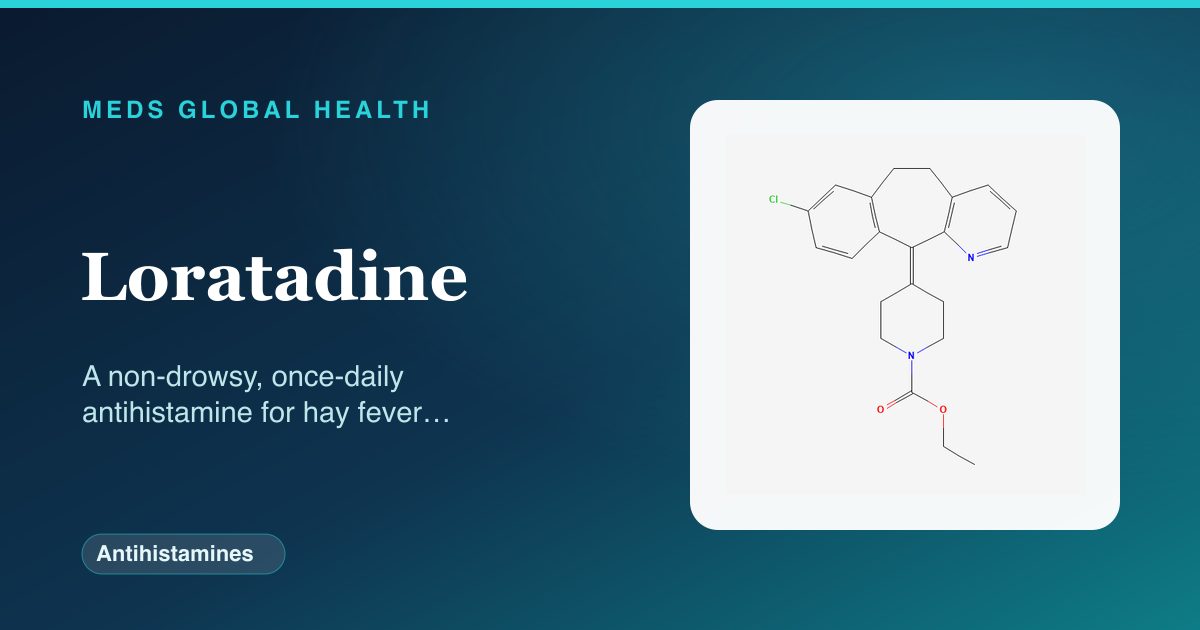
What it is
Loratadine is a "non-drowsy" (second-generation) antihistamine. It is used for the symptoms of allergy — sneezing, a runny or itchy nose and itchy, watery eyes in hay fever (allergic rhinitis), as well as itchy skin rashes such as hives (urticaria). Because it causes little or no drowsiness in most people, it is suitable for daytime use, including for people who drive or operate machinery. It is widely available over the counter and is a long-standing first-choice allergy tablet.
How it works
When the body meets something it is allergic to, cells release histamine, a chemical that produces the familiar allergy symptoms — itching, sneezing, a runny nose and watery eyes. Loratadine blocks the histamine (H1) receptors that these symptoms work through, so the reaction is calmed. Unlike the older antihistamines, loratadine does not cross easily into the brain, which is why it relieves allergy symptoms without causing much drowsiness.
Company & origin
Originated / developed by: Schering-Plough (now Merck & Co.).
Loratadine was developed by Schering-Plough in the United States, with patents dating to the early 1980s. The non-sedating antihistamine was approved by the FDA in 1993 and marketed as Claritin/Clarityn; Schering-Plough was later acquired by Merck & Co.
What it treats
Conditions Loratadine is used for
Practical use
How to take Loratadine
General, dose-free guidance — always follow your prescriber's and the leaflet's specific instructions.
- Take it once a day, with or without food, at a time you will remember.
- For seasonal allergies, you can take it regularly through the season or when symptoms are expected.
- It is described as non-drowsy, but a few people still feel sleepy, so see how it affects you before driving.
- Avoid taking other antihistamines at the same time unless advised.
- Speak to a pharmacist if symptoms do not improve or you need it for a long time.
Weighing it up
Advantages & disadvantages of Loratadine
Advantages
- Relieves allergy symptoms without making most people drowsy.
- Taken just once a day.
- Widely available and suitable for many adults and children.
- Generally well tolerated with few interactions.
Disadvantages
- Does not work for everyone and may not fully control severe allergies.
- A small number of people still feel drowsy.
- Can occasionally cause headache, dry mouth or tiredness.
- Treats symptoms only and does not cure the underlying allergy.
- May need an adjustment in people with liver or kidney problems.
Practical use
Good to know
It is usually taken once a day and can be used as needed during the allergy season or regularly through it. It can be bought from pharmacies and supermarkets, making it easy to access. It is generally very well tolerated and only rarely causes drowsiness. If hay fever symptoms are not controlled by an antihistamine alone, adding a steroid nasal spray often helps, and a pharmacist can advise. Cetirizine is a similar non-drowsy antihistamine; some people find one suits them better than the other.
Who should not take it / use with caution
- People with a known sensitivity to loratadine.
- Used with care in significant liver impairment, where a gentler approach is taken.
- As with any medicine in pregnancy or breastfeeding, it is best to check with a pharmacist first, although it is generally considered a suitable option.
Monitoring
- Symptom response; usually none needed
- Review if symptoms are not controlled
- Liver function only where relevant
Side effects
- Usually very well tolerated; occasionally headache or tiredness.
- Rarely drowsiness — less than with the older sedating antihistamines.
- Uncommonly a dry mouth or, very rarely, a rash or allergic reaction.
Key interactions
- Few important interactions — one of the reasons it is a popular first choice.
- Some medicines can raise its levels in the body, but this is rarely a practical problem at usual amounts.
- Tell your pharmacist about other medicines if you take loratadine regularly.
Available as: Tablets and a liquid (syrup) suitable for children and those who cannot swallow tablets; widely available over the counter.
Answers
Loratadine: frequently asked questions
Will loratadine make me drowsy?
Usually not — loratadine is a "non-drowsy" antihistamine, because it does not cross easily into the brain. A small number of people do feel a little sleepy, so it is wise to see how it affects you before driving, but for most people it relieves allergy symptoms without making them tired.
Can I buy loratadine without a prescription?
Yes — loratadine is available over the counter from pharmacies and supermarkets for hay fever and itchy rashes. A pharmacist can advise on whether it suits you and what to add (such as a steroid nasal spray) if symptoms are not fully controlled.
What is the difference between loratadine and cetirizine?
Both are non-drowsy antihistamines that work in a similar way for hay fever and hives. Cetirizine can occasionally be slightly more sedating than loratadine in some people. There is no single "best" one — people sometimes find one suits them better, so it can be worth trying the other if the first does not help.
Can I take loratadine every day during hay fever season?
Yes — for ongoing seasonal allergy it is fine to take it regularly through the season, as well as on an as-needed basis. If symptoms persist despite taking it daily, a pharmacist or GP can suggest adding or switching treatments.
What is the difference between loratadine and Clarityn or Claritin?
They are the same medicine — loratadine is the generic (active-ingredient) name, Clarityn is the UK brand name and Claritin is the US brand name (the spelling differs between the two countries). The active ingredient is identical.
The wider class
About Antihistamines
Loratadine belongs to the antihistamines class. For how the class as a whole works, its shared safety principles and monitoring, see the full guide.
Browse by body system
Authoritative sources
- BNF: Loratadine.
- NICE CKS: Allergic rhinitis.
- NICE CKS: Loratadine.
Building a medicines information resource?
We create evidence-led, dose-free drug and formulary references for teams.