A non-drowsy antihistamine
Rupatadine
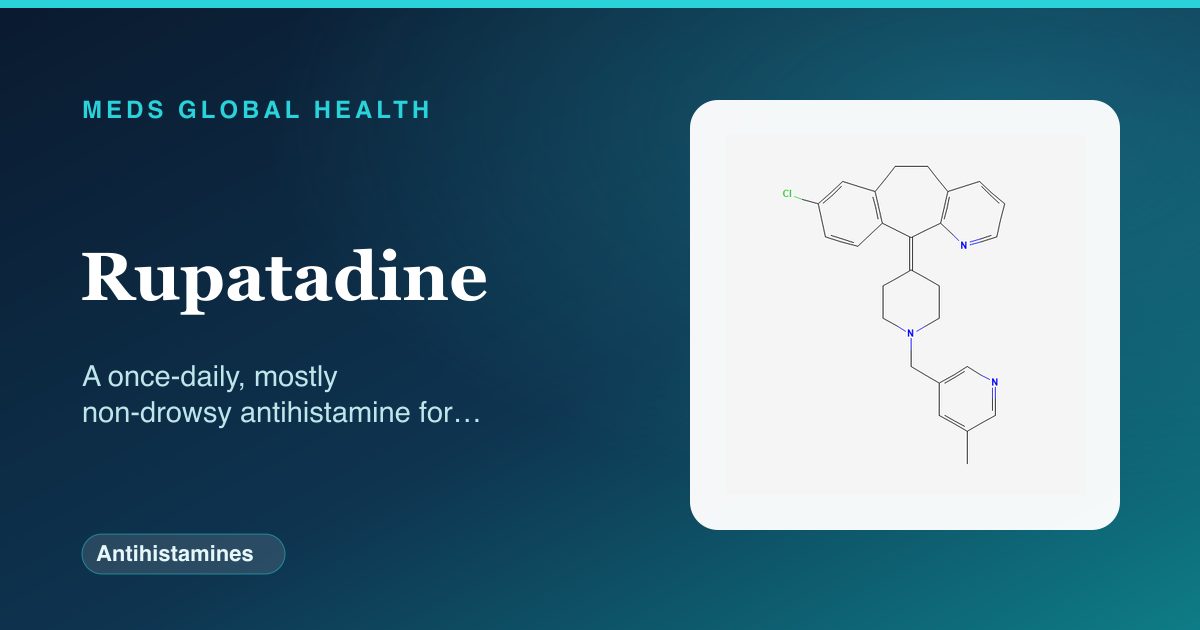
A once-daily, mostly non-drowsy antihistamine for hay fever and chronic hives.
What is Rupatadine?
Rupatadine is a non-drowsy (second-generation) antihistamine taken once a day for hay fever (allergic rhinitis) and chronic hives (urticaria). It blocks histamine, the substance that causes itching, sneezing and a runny nose during allergic reactions. It is best taken without grapefruit and, although mostly non-drowsy, can still make some people sleepy.
Education and reference only. This is a plain-language guide to Rupatadine — it deliberately contains no doses. Doses depend on the person, the brand and the reason for treatment, and belong with your prescriber. Always check the BNF, the product labelling (SmPC) and follow medical advice.
What it is
Rupatadine is a second-generation, mostly non-drowsy antihistamine. In the UK it is used to relieve the symptoms of hay fever and other allergic rhinitis, and of chronic spontaneous urticaria (long-lasting hives). It is designed to last through the day with a single daily dose.
How it works
When the body meets an allergy trigger such as pollen, it releases histamine, which causes itching, sneezing, a runny or blocked nose and hives. Rupatadine blocks the histamine receptors so these effects are reduced. As a newer antihistamine it crosses into the brain far less than older ones, so it is much less likely to cause drowsiness.
Company & origin
Originated / developed by: Developed by Uriach; available in the UK as Rupafin and as a generic medicine..
Developed in Spain by Uriach and used in the UK for hay fever and chronic hives.
What it treats
Conditions Rupatadine is used for
Practical use
How to take Rupatadine
General, dose-free guidance — always follow your prescriber's and the leaflet's specific instructions.
- Take it once a day, at about the same time each day.
- Avoid grapefruit and grapefruit juice while taking it.
- See how it affects you before driving, as it can occasionally cause drowsiness.
- It can be taken with or without food.
- For hay fever you may only need it during the pollen season; for hives it may be taken regularly.
- If a dose is missed, take it when you remember unless the next one is near, then skip it; never double up.
Weighing it up
Advantages & disadvantages of Rupatadine
Advantages
- Taken just once a day, which is simple and convenient.
- Mostly non-drowsy, so suits people who need to stay alert.
- Effective for both hay fever and chronic hives, and available as a generic medicine.
Disadvantages
- Can still cause drowsiness in some people despite being a non-drowsy type.
- Interacts with grapefruit, which should be avoided.
- Like other antihistamines it eases symptoms rather than curing the underlying allergy.
Practical use
Good to know
Rupatadine is taken once a day, which is convenient. It is best to avoid grapefruit and grapefruit juice, which can raise the amount of medicine in your blood. Although it is classed as non-drowsy, some people do still feel sleepy, so see how it affects you before driving or drinking alcohol.
Who should not take it / use with caution
- People who have had an allergic reaction to rupatadine or similar antihistamines.
- People with significant heart-rhythm problems should use it with caution.
- People with severe kidney or liver problems, without medical advice.
Monitoring
- How well allergy symptoms are controlled.
- Any drowsiness before driving or operating machinery.
- Generally no routine blood tests are needed.
Side effects
- Drowsiness or tiredness in some people.
- Headache.
- Dry mouth.
- Dizziness.
Key interactions
- Grapefruit and grapefruit juice, which raise its blood levels.
- Some antifungals and antibiotics that change how it is broken down.
- Alcohol and other sedating medicines, which may add to any drowsiness.
Available as: Available as tablets and as an oral solution.
Answers
Rupatadine: frequently asked questions
Will rupatadine make me drowsy?
It is classed as a non-drowsy antihistamine and crosses into the brain much less than older ones. Even so, some people do feel sleepy, so see how it affects you before driving or drinking alcohol.
Can I drink grapefruit juice with it?
It is best avoided. Grapefruit and its juice can raise the level of rupatadine in your blood and increase the chance of side effects.
What is it used for?
It is used for hay fever and other allergic rhinitis, with symptoms like sneezing and a runny nose, and for chronic hives (long-lasting urticaria).
How often do I take it?
Once a day, at around the same time. For hay fever you may only need it during the pollen season, while for hives it may be taken regularly.
Does it cure my allergy?
No. Like other antihistamines it controls the symptoms rather than curing the underlying allergy, so symptoms may return if you stop it while still exposed to the trigger.
The wider class
About Antihistamines
Rupatadine belongs to the antihistamines class. For how the class as a whole works, its shared safety principles and monitoring, see the full guide.
Browse by body system
Authoritative sources
- BNF
- NICE CKS
Building a medicines information resource?
We create evidence-led, dose-free drug and formulary references for teams.