A sedating antihistamine for allergies and itch
Clemastine
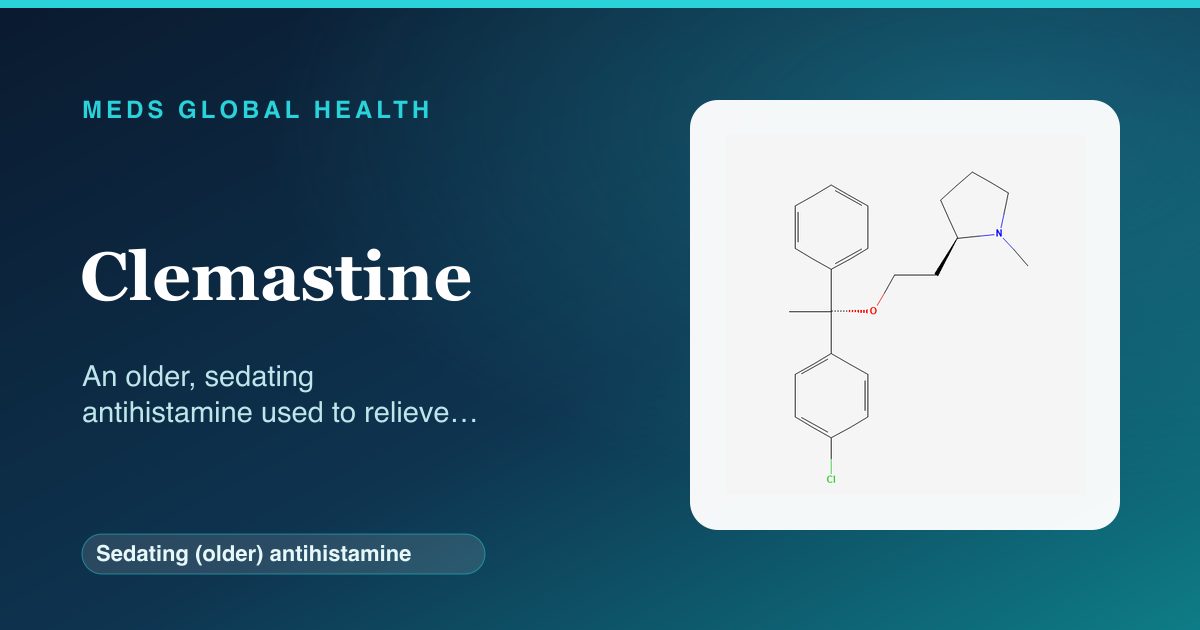
An older, sedating antihistamine used to relieve allergy symptoms and itching.
What is Clemastine?
Clemastine is an older, sedating antihistamine used to relieve allergy symptoms such as a runny or itchy nose, watery eyes, hives and itching. It works by blocking histamine, the chemical released during allergic reactions. Its main drawback is that it commonly causes drowsiness, so you should not drive or use machinery if you feel affected, and it can add to the effects of alcohol. It also has antimuscarinic effects, such as a dry mouth, and is used with caution in people with glaucoma or prostate problems.
Education and reference only. This is a plain-language guide to Clemastine — it deliberately contains no doses. Doses depend on the person, the brand and the reason for treatment, and belong with your prescriber. Always check the BNF, the product labelling (SmPC) and follow medical advice.
What it is
Clemastine is an older type of antihistamine, sometimes called a sedating or first-generation antihistamine. It is used to relieve allergy symptoms, including a runny or itchy nose, sneezing, watery eyes, hives (urticaria) and itchy skin. It is taken by mouth. Because it is an older antihistamine, it tends to cause more drowsiness than the newer non-drowsy ones, which is its most noticeable feature. It is a long-established medicine that can be useful when an antihistamine is needed, particularly where its sedating effect is not a problem or is even helpful.
How it works
During an allergic reaction the body releases a chemical called histamine, which causes itching, sneezing, a runny nose, watery eyes and hives. Clemastine blocks the action of histamine, so these symptoms are reduced. Because it is an older antihistamine, it also crosses into the brain, which is why it tends to cause drowsiness, and it has some antimuscarinic activity, which can cause effects such as a dry mouth. Newer antihistamines were designed to block histamine while crossing into the brain less, so they cause less drowsiness.
Company & origin
An older sedating antihistamine used in the UK to relieve allergy symptoms and itch.
What it treats
Conditions Clemastine is used for
Practical use
How to take Clemastine
General, dose-free guidance — always follow your prescriber's and the leaflet's specific instructions.
- Take it by mouth as directed for allergy symptoms or itch.
- Do not drive or use machinery if it makes you feel drowsy.
- Avoid or limit alcohol, as it adds to the drowsiness.
- Tell your prescriber if you have glaucoma, prostate problems or difficulty passing urine before using it.
- Ask your pharmacist about a non-drowsy antihistamine if daytime sleepiness is a problem.
Weighing it up
Advantages & disadvantages of Clemastine
Advantages
- Relieves allergy symptoms such as itching, sneezing, a runny nose and hives.
- Its sedating effect can be helpful when itching disturbs sleep at night.
- A long-established, well-understood medicine.
Disadvantages
- Commonly causes drowsiness, so it is not ideal for driving or daytime alertness.
- Has antimuscarinic effects such as a dry mouth, and is used with caution in glaucoma or prostate problems.
- Older people are more sensitive to its drowsy and antimuscarinic effects.
Practical use
Good to know
The most important practical point about clemastine is drowsiness: it commonly makes people feel sleepy, so you should not drive or operate machinery if you are affected, and you should be careful with alcohol, which adds to the sedation. For some people the sedating effect can be helpful, for example when itching is worse at night. It also has antimuscarinic effects, which can cause a dry mouth, blurred vision, constipation or difficulty passing urine, and because of these it is used with caution in people with glaucoma, an enlarged prostate or urinary problems. Older people are more sensitive to both the drowsiness and the antimuscarinic effects. If you need a non-drowsy option for daytime allergy relief, ask your pharmacist about newer antihistamines.
Who should not take it / use with caution
- People who have had a serious allergic reaction to clemastine should not use it.
- It is used with caution in people with glaucoma, an enlarged prostate or difficulty passing urine.
- It is used with caution in older people, who are more sensitive to drowsiness and antimuscarinic effects.
- Care is needed with alcohol and other medicines that cause drowsiness.
Monitoring
- Checking how drowsy it makes you and whether it affects driving or daily activities.
- Watching for antimuscarinic effects, especially in older people and those with prostate or glaucoma problems.
- Reviewing whether a non-drowsy antihistamine would suit you better for daytime use.
Side effects
- Drowsiness or sleepiness, sometimes lasting into the next day.
- Dry mouth, blurred vision or constipation from its antimuscarinic effects.
- Difficulty passing urine, especially in men with prostate problems.
- Dizziness or, occasionally, confusion, particularly in older people.
Key interactions
- Alcohol and other sedating medicines add to its drowsiness.
- Other antimuscarinic medicines can add to effects such as dry mouth and constipation.
- It may add to the sedating effect of some painkillers, sleeping tablets and certain antidepressants.
Available as: Tablets and a liquid taken by mouth.
Answers
Clemastine: frequently asked questions
What is clemastine used for?
It is a sedating antihistamine used to relieve allergy symptoms such as a runny or itchy nose, watery eyes, hives and itching.
Will it make me drowsy?
Yes, it commonly causes drowsiness, so you should not drive or use machinery if affected, and you should be careful with alcohol.
How is it different from newer antihistamines?
Newer antihistamines cross into the brain less, so they cause much less drowsiness; clemastine is an older, sedating type.
Who should be careful with it?
People with glaucoma, an enlarged prostate or urinary problems, and older people, because of its antimuscarinic and drowsy effects.
Can the drowsiness ever be useful?
Yes, the sedating effect can help some people when itching is worse at night, but a non-drowsy option is better for daytime alertness.
The wider class
About Sedating (older) antihistamine
Clemastine belongs to the sedating (older) antihistamine class. For how the class as a whole works, its shared safety principles and monitoring, see the full guide.
Browse by body system
Authoritative sources
- BNF
- NICE CKS
Building a medicines information resource?
We create evidence-led, dose-free drug and formulary references for teams.