A second-generation antipsychotic
Asenapine
A second-generation antipsychotic taken as a tablet that dissolves under the tongue, used for bipolar disorder.
What is Asenapine?
Asenapine is a second-generation (atypical) antipsychotic used to treat manic episodes in bipolar disorder. It is unusual because it is a sublingual tablet that dissolves under the tongue, rather than being swallowed. You should not eat or drink for a short while after taking it, and it can briefly numb the mouth.
Education and reference only. This is a plain-language guide to Asenapine — it deliberately contains no doses. Doses depend on the person, the brand and the reason for treatment, and belong with your prescriber. Always check the BNF, the product labelling (SmPC) and follow medical advice.
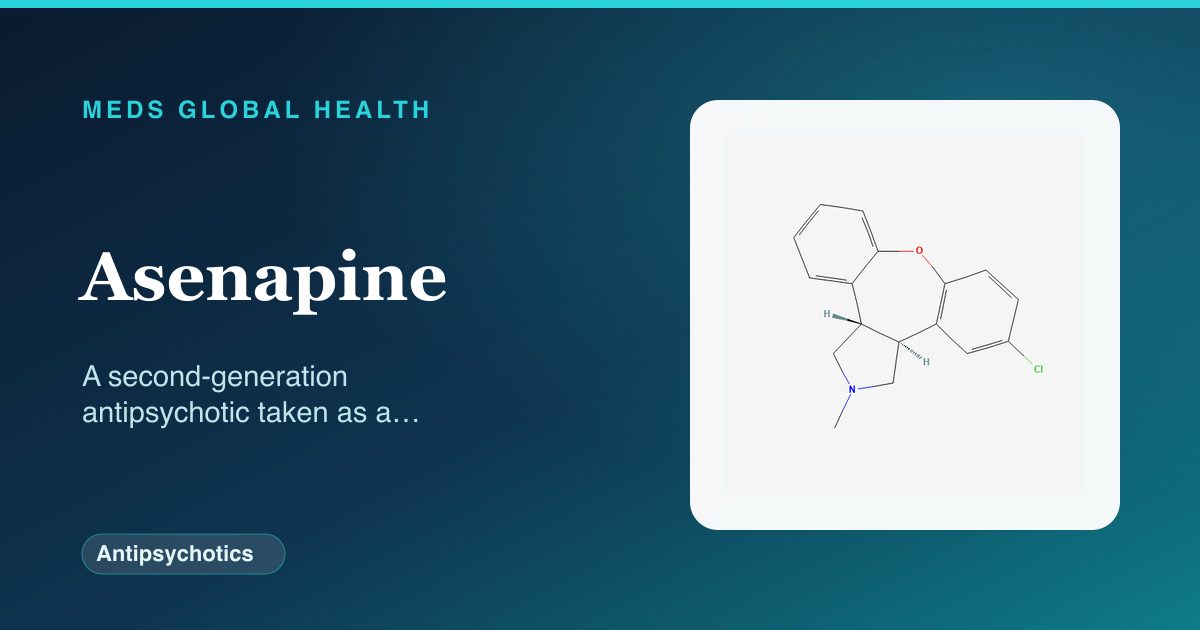
What it is
Asenapine is a newer, second-generation antipsychotic used mainly to treat moderate to severe manic episodes in bipolar disorder. Its distinctive feature is the way it is taken: it is a sublingual tablet that is placed under the tongue and allowed to dissolve, because it is not absorbed well if swallowed.
How it works
Asenapine acts on several brain-chemical systems, including dopamine and serotonin receptors. Balancing these signals helps stabilise mood and reduce the symptoms of mania, such as racing thoughts, overactivity and irritability. Because it is poorly absorbed from the stomach, it is absorbed instead through the lining of the mouth.
Company & origin
Originated / developed by: Branded in the UK as Sycrest..
Asenapine is a second-generation (atypical) antipsychotic given as a sublingual tablet that dissolves under the tongue.
What it treats
Conditions Asenapine is used for
Practical use
How to take Asenapine
General, dose-free guidance — always follow your prescriber's and the leaflet's specific instructions.
- Place the tablet under your tongue and let it dissolve fully; do not swallow, chew or crush it.
- Do not eat or drink for about ten minutes after taking it, so it can be absorbed properly.
- Take it with dry hands and put it under your tongue straight away after removing it from the pack.
- It may briefly numb your mouth or change your sense of taste; this usually passes.
- Do not stop taking it suddenly, as this can cause withdrawal effects or a relapse; any change should be planned.
Weighing it up
Advantages & disadvantages of Asenapine
Advantages
- Effective for manic episodes in bipolar disorder.
- Dissolves under the tongue, which can suit people who find swallowing tablets difficult.
- As a newer antipsychotic, it is somewhat less likely to cause raised prolactin than some older medicines.
Disadvantages
- Must be taken correctly under the tongue, with no food or drink for a short time afterwards, which some find inconvenient.
- Commonly causes mouth numbness and altered taste.
- Can cause weight gain, drowsiness and movement side effects such as restlessness.
Practical use
Good to know
Asenapine is a sublingual tablet: place it under the tongue and let it dissolve, do not swallow, chew or crush it. Do not eat or drink for about ten minutes afterwards. It commonly causes temporary numbness or altered taste in the mouth. Do not stop it suddenly. Seek urgent help (999 or A&E) if you develop a high temperature with severe muscle stiffness, confusion and a fast heartbeat — this can signal a rare but serious reaction called neuroleptic malignant syndrome.
Who should not take it / use with caution
- People with a known allergy to asenapine.
- People with severe liver problems.
- Used with caution in heart disease, diabetes, epilepsy and in older people, particularly those with dementia.
Monitoring
- Regular review of mood, symptoms and side effects.
- Weight, blood sugar and cholesterol (metabolic monitoring).
- Blood pressure and, where appropriate, an ECG (heart tracing).
Side effects
- Numbness or tingling of the mouth and altered taste after taking it.
- Drowsiness and dizziness.
- Movement effects, particularly restlessness (akathisia) and tremor.
- Weight gain and changes in blood sugar and cholesterol (metabolic effects).
- Dizziness on standing (postural hypotension).
- Rarely, effects on heart rhythm (QT prolongation) or serious allergic reactions.
Key interactions
- Alcohol and other sedating medicines increase drowsiness.
- Medicines that affect heart rhythm may add to the risk of QT problems.
- Some antidepressants and other medicines can interact; tell your team about all your medicines.
- Avoid eating or drinking immediately after the tablet, as this reduces how much is absorbed.
Available as: Sublingual tablets (dissolved under the tongue).
Answers
Asenapine: frequently asked questions
Why do I put the tablet under my tongue?
Asenapine is not absorbed well from the stomach, so it is given as a sublingual tablet that dissolves under the tongue and is absorbed through the lining of the mouth. Swallowing it would make it much less effective.
Why can't I eat or drink straight afterwards?
Eating or drinking too soon washes the medicine away before it is absorbed. Wait about ten minutes after the tablet dissolves before having food or drink.
Is the mouth numbness normal?
Yes, temporary numbness, tingling or altered taste in the mouth is common with asenapine and usually settles. Tell your team if it is troublesome.
What is neuroleptic malignant syndrome?
It is a rare but serious reaction to antipsychotics. Warning signs include high temperature, severe muscle stiffness, confusion, a fast or irregular heartbeat and sweating. This is a medical emergency: seek urgent help (call 999 or go to A&E) straight away.
Can I stop asenapine if I feel better?
Do not stop suddenly. Stopping abruptly can cause withdrawal effects or bring symptoms back. Any change should be planned with your team.
The wider class
About Antipsychotics
Asenapine belongs to the antipsychotics class. For how the class as a whole works, its shared safety principles and monitoring, see the full guide.
Browse by body system
Authoritative sources
- BNF: Asenapine.
- NICE CKS: Antipsychotics.
Building a medicines information resource?
We create evidence-led, dose-free drug and formulary references for teams.