An antipsychotic for Parkinson's-disease psychosis
Pimavanserin
A medicine used to treat the hallucinations and delusions (psychosis) that can occur in Parkinson's disease.
What is Pimavanserin?
Pimavanserin is a specialist antipsychotic used to treat the hallucinations and delusions (psychosis) that can occur in Parkinson's disease. It works differently from older antipsychotics by acting on a serotonin signal in the brain, which means it is less likely to worsen the movement problems of Parkinson's. It can affect the heart's electrical rhythm (the QT interval), so the heart may be checked. Importantly, like other antipsychotics, it carries a raised risk of death when used in elderly people who have dementia-related psychosis, so it is used carefully under specialist supervision.
Education and reference only. This is a plain-language guide to Pimavanserin — it deliberately contains no doses. Doses depend on the person, the brand and the reason for treatment, and belong with your prescriber. Always check the BNF, the product labelling (SmPC) and follow medical advice.
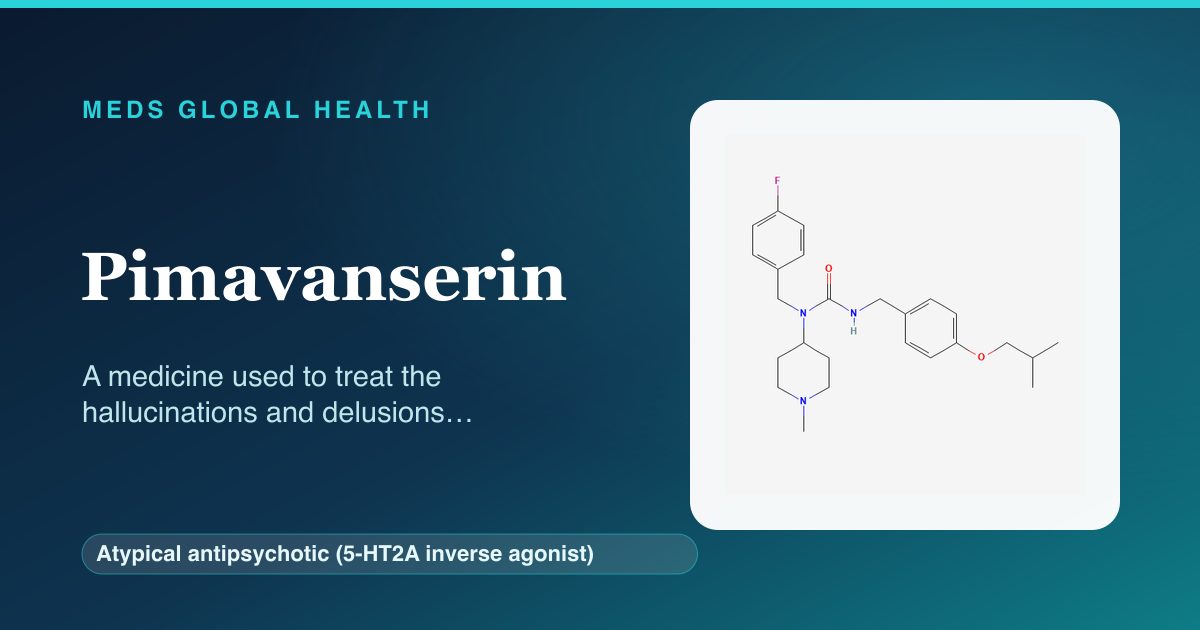
What it is
Pimavanserin is an atypical antipsychotic used to treat the hallucinations and delusions that can develop as part of Parkinson's disease. Older antipsychotics block dopamine, which can make the movement problems of Parkinson's worse, so they are difficult to use in this setting. Pimavanserin instead works mainly on a serotonin signal, which is why it can help the psychosis without worsening movement in the same way. It is taken by mouth and is prescribed and supervised by a specialist, with attention to the heart's rhythm and to the particular risks of using antipsychotics in older people.
How it works
Pimavanserin acts as an inverse agonist at a serotonin receptor in the brain (the 5-HT2A receptor), which is thought to be involved in the hallucinations and delusions seen in Parkinson's-disease psychosis. By dampening this signal rather than blocking dopamine, it can reduce these symptoms while leaving the dopamine pathways that control movement largely untouched. This is why it is less likely than older antipsychotics to stiffen movement or worsen Parkinson's. It works gradually over the early weeks of treatment, and its effect is judged over time.
Company & origin
A specialist medicine used to treat the hallucinations and delusions that can occur in Parkinson's disease, designed not to worsen movement.
What it treats
Conditions Pimavanserin is used for
Practical use
How to take Pimavanserin
General, dose-free guidance — always follow your prescriber's and the leaflet's specific instructions.
- Take it by mouth as prescribed, at about the same time each day to keep levels steady.
- Do not expect an instant effect; the benefit on hallucinations and delusions builds over the early weeks.
- Tell your prescriber about any heart-rhythm problems or other medicines that affect the heart rhythm.
- Do not stop it suddenly without advice, as your specialist will decide how to adjust or stop it.
- Report any new confusion, drowsiness or worsening symptoms to your specialist team.
Weighing it up
Advantages & disadvantages of Pimavanserin
Advantages
- Treats the hallucinations and delusions of Parkinson's-disease psychosis.
- Less likely than older antipsychotics to worsen the movement problems of Parkinson's.
- Taken by mouth as a once-daily option.
Disadvantages
- Like all antipsychotics, carries a raised risk of death in elderly people with dementia-related psychosis.
- Can lengthen the heart's electrical rhythm (the QT interval) and may need ECG monitoring.
- Works gradually rather than immediately, so benefit takes time to judge.
Practical use
Good to know
The most important thing to understand is a class warning that applies to all antipsychotics: when they are used in elderly people with dementia-related psychosis, there is a raised risk of death, so the decision to use pimavanserin is weighed very carefully in this group. A key practical safety point is that it can lengthen the heart's electrical rhythm (the QT interval), so an electrocardiogram (ECG) and a review of other QT-affecting medicines may be done before and during treatment. A real advantage in Parkinson's is that, unlike older antipsychotics, it is less likely to worsen the movement symptoms of the condition. It works gradually, so the benefit is judged over the first weeks. As with all of these medicines, it is used under specialist supervision with regular review.
Who should not take it / use with caution
- People who have had a serious allergic reaction to pimavanserin should not take it.
- It is used with great caution, if at all, in elderly people with dementia-related psychosis because of the raised risk of death.
- It is used with caution in people with heart-rhythm problems or those taking other medicines that affect the QT interval.
Monitoring
- An electrocardiogram (ECG) to check the heart's rhythm before and during treatment where appropriate.
- Reviewing how well the hallucinations and delusions respond over the early weeks.
- Watching for confusion, drowsiness or worsening symptoms, particularly in the elderly.
Side effects
- Swelling of the legs or ankles, nausea or constipation.
- Confusion or drowsiness in some people, particularly the elderly.
- Less commonly, changes in the heart's electrical rhythm (the QT interval).
Key interactions
- Medicines that also affect the heart's QT interval should be reviewed, as the effect can add up.
- Some medicines change how pimavanserin is broken down, so the dose may need adjusting.
- Give a full list of your medicines, as several can interact with pimavanserin.
Available as: Capsules or tablets taken by mouth.
Answers
Pimavanserin: frequently asked questions
What is pimavanserin used for?
It is used to treat the hallucinations and delusions (psychosis) that can occur in Parkinson's disease, working on a serotonin signal in the brain.
Will it make my Parkinson's worse?
Unlike older antipsychotics, it is less likely to worsen the movement problems of Parkinson's, because it does not block dopamine in the same way.
Why is there a warning about elderly people with dementia?
Like all antipsychotics, it carries a raised risk of death when used in elderly people with dementia-related psychosis, so it is used very carefully in this group.
Does it affect the heart?
It can lengthen the heart's electrical rhythm (the QT interval), so your team may do an ECG and review other medicines that affect the heart rhythm.
How quickly does it work?
It works gradually, so the benefit on hallucinations and delusions is judged over the first weeks rather than straight away.
The wider class
About Atypical antipsychotic (5-HT2A inverse agonist)
Pimavanserin belongs to the atypical antipsychotic (5-ht2a inverse agonist) class. For how the class as a whole works, its shared safety principles and monitoring, see the full guide.
Browse by body system
Authoritative sources
- BNF
- NICE CKS
Building a medicines information resource?
We create evidence-led, dose-free drug and formulary references for teams.