An atypical (second-generation) antipsychotic
Risperidone
A widely used atypical antipsychotic for schizophrenia and bipolar disorder, available as tablets and a long-acting injection; it tends to raise prolactin.
What is Risperidone?
Risperidone is a commonly prescribed atypical (second-generation) antipsychotic. It is used to treat schizophrenia, episodes of mania in bipolar disorder, and, for limited periods, persistent aggression in some other conditions.
Education and reference only. This is a plain-language guide to Risperidone — it deliberately contains no doses. Doses depend on the person, the brand and the reason for treatment, and belong with your prescriber. Always check the BNF, the product labelling (SmPC) and follow medical advice.
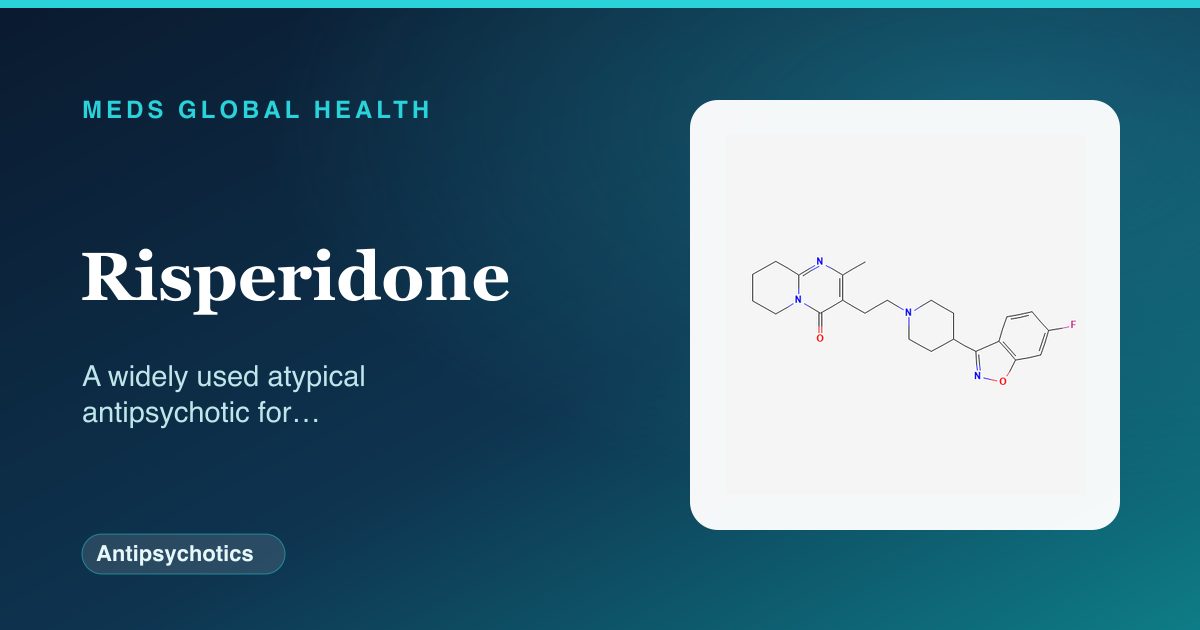
What it is
Risperidone is one of the most commonly prescribed atypical ("second-generation") antipsychotics in the UK. It is used to treat schizophrenia and to manage the manic (high) phases of bipolar disorder, and is sometimes used short-term for severe, persistent aggression in certain conditions. It is taken long-term to keep symptoms settled rather than as a quick fix, and is available both as tablets (including a tablet that melts on the tongue) and as a long-acting injection given by a nurse. In the UK and US the active ingredient and the original brand (Risperdal) are the same; generic risperidone is identical.
How it works
Risperidone works mainly by blocking dopamine receptors in the brain, which dampens the over-active dopamine signalling thought to drive symptoms such as hallucinations, delusions and disordered thinking. It also blocks serotonin receptors, which is part of what makes "atypical" antipsychotics differ from older ones and can ease some symptoms while reducing certain movement side effects. Because it also affects the dopamine pathway that normally keeps the hormone prolactin in check, risperidone tends to raise prolactin levels, which explains several of its hormonal side effects.
Company & origin
Originated / developed by: Janssen Pharmaceutica.
Risperidone was developed in the 1980s by Janssen Pharmaceutica (Belgium, part of Johnson & Johnson) and received US FDA approval in December 1993, marketed as Risperdal.
What it treats
Conditions Risperidone is used for
Practical use
How to take Risperidone
General, dose-free guidance — always follow your prescriber's and the leaflet's specific instructions.
- Take risperidone regularly as prescribed, even when you feel well, as it works best when taken consistently.
- Do not stop it suddenly without advice, as symptoms can return or worsen; any change should be planned with your team.
- Stand up slowly when you start or change treatment, as it can lower blood pressure and cause dizziness early on.
- Tell your prescriber about stiffness, tremor, restlessness or unusual movements, as these can be side effects.
- Attend any agreed monitoring of weight, blood sugar and other health checks during treatment.
Weighing it up
Advantages & disadvantages of Risperidone
Advantages
- Effective for schizophrenia and for manic episodes in bipolar disorder.
- Generally less likely to cause heavy sedation than some older antipsychotics.
- Available in different forms, including a long-acting injection.
- Well-studied medicine with a long track record.
Disadvantages
- Can cause movement side effects such as stiffness, tremor and restlessness.
- May raise the hormone prolactin, leading to effects such as breast tenderness or changes in periods.
- Can cause weight gain and affect blood sugar and cholesterol, so monitoring is needed.
- May cause drowsiness and dizziness on standing, and is used cautiously in older people with dementia.
Practical use
Good to know
It is usually started low and built up gradually, and is taken regularly every day to keep symptoms stable — it is not a medicine to take only when you feel unwell. Stopping it suddenly can allow symptoms to return or cause withdrawal effects, so any change is made gradually and with your team. A long-acting injection version exists for people who would prefer not to take daily tablets or who find a regular tablet routine difficult. Because it can raise prolactin, it may cause breast tenderness or milk production and sexual or period changes; these are worth reporting. Weight, blood sugar and cholesterol are checked over time, as antipsychotics can affect them.
Who should not take it / use with caution
- Older people with dementia are treated with particular caution — antipsychotics raise the risk of stroke and death in this group, so they are used only when clearly needed, at the lowest helpful intensity and for the shortest time.
- People with significant heart rhythm problems, very low blood pressure, or a history of certain blood-related reactions to antipsychotics need careful assessment first.
- Used with caution in Parkinson's disease and related conditions, epilepsy, significant kidney or liver impairment, and in pregnancy or breastfeeding, where the balance of benefit and risk is weighed individually.
Monitoring
- Mental state and response to treatment
- Weight, blood sugar and cholesterol over time
- Blood pressure and pulse; prolactin and movement side effects where relevant
Side effects
- Drowsiness, dizziness (especially on standing), weight gain, and a blocked or runny nose are common, particularly early on.
- Raised prolactin can cause breast swelling or milk production (in either sex), reduced sex drive, erection or period changes.
- At higher intensity, movement effects such as stiffness, tremor, restlessness or slowed movement can appear; rarely, longer-term involuntary movements (tardive dyskinesia), or a serious reaction with high fever and muscle rigidity (neuroleptic malignant syndrome) that needs emergency care.
Key interactions
- Adds to drowsiness with alcohol, strong painkillers, sleeping tablets and other sedating medicines.
- Other medicines that lower blood pressure can increase dizziness and fainting when combined with it.
- Care alongside medicines that affect the heart's rhythm, with certain antidepressants and seizure medicines that can change its levels, and it can oppose the effect of Parkinson's medicines.
Available as: Tablets, a tablet that dissolves on the tongue, an oral liquid, and a long-acting injection given by a healthcare professional.
Answers
Risperidone: frequently asked questions
Why does risperidone cause breast changes or milk production?
Risperidone raises a hormone called prolactin, which normally controls breast milk. This can cause breast tenderness, swelling or milk production in either sex, as well as changes to sex drive, erections or periods. Mention any of these to your prescriber — the medicine can sometimes be adjusted or switched to one less likely to affect prolactin.
Can I stop risperidone once I feel well?
Feeling well usually means the medicine is working, not that it is no longer needed. Stopping suddenly can let symptoms return and can cause withdrawal effects, so any change should be planned with your team and made gradually rather than stopped on your own.
Is the long-acting injection better than tablets?
Neither is automatically "better" — they contain the same active ingredient. The injection is given by a nurse at intervals and removes the need to remember daily tablets, which some people prefer or find more reliable. Your team can help you decide which suits you.
Why is risperidone used so carefully in older people with dementia?
In people with dementia, antipsychotics including risperidone slightly raise the risk of stroke and of death. Because of this they are used only when truly necessary — for example for severe distress or risk — at the lowest helpful intensity and for the shortest time, with regular review.
What is the difference between risperidone and Risperdal?
They are the same medicine — risperidone is the generic (active-ingredient) name and Risperdal is the original brand name, used in both the UK and US. Generic risperidone contains the identical active ingredient.
The wider class
About Antipsychotics
Risperidone belongs to the antipsychotics class. For how the class as a whole works, its shared safety principles and monitoring, see the full guide.
Browse by body system
Authoritative sources
- BNF: Risperidone.
- electronic Medicines Compendium (SmPC): Risperidone (Risperdal).
- NICE CKS: Risperidone.
Building a medicines information resource?
We create evidence-led, dose-free drug and formulary references for teams.