A first-generation antipsychotic, available as a depot injection
Fluphenazine
An older antipsychotic used for schizophrenia, often as a long-acting depot injection that lasts for weeks.
What is Fluphenazine?
Fluphenazine is a first-generation (older or 'typical') antipsychotic used mainly to treat schizophrenia. It is often given as a long-acting 'depot' injection into a muscle, which slowly releases the medicine over weeks, helping people who find it hard to take daily tablets. Its main concerns are movement-related side effects, including stiffness, restlessness, tremor and, with long-term use, tardive dyskinesia (lasting abnormal movements), along with drowsiness, a rise in the hormone prolactin, and effects on the heart's rhythm. It is prescribed and monitored by a specialist mental-health team.
Education and reference only. This is a plain-language guide to Fluphenazine — it deliberately contains no doses. Doses depend on the person, the brand and the reason for treatment, and belong with your prescriber. Always check the BNF, the product labelling (SmPC) and follow medical advice.
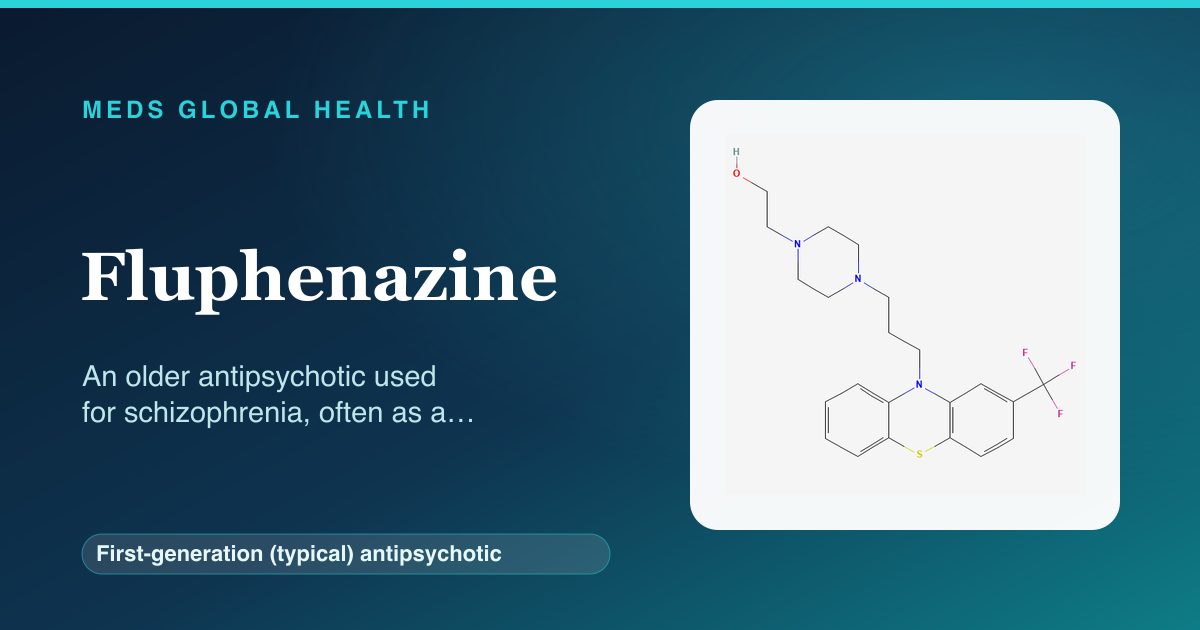
What it is
Fluphenazine is an older antipsychotic medicine, from the first-generation or 'typical' group, used to treat schizophrenia and similar conditions involving disturbed thoughts and perceptions. A key feature is that it can be given as a long-acting depot injection into a muscle, which then releases the medicine slowly over several weeks; this can be helpful for people who would prefer not to, or find it difficult to, take tablets every day. It calms the symptoms of psychosis and helps prevent relapse. It is prescribed and supervised by a specialist mental-health team.
How it works
Fluphenazine works mainly by blocking dopamine, a chemical messenger in the brain. In schizophrenia, overactivity of dopamine in certain brain pathways is linked to symptoms such as hearing voices and holding false beliefs, and dampening this activity helps reduce them. Because it blocks dopamine quite strongly, it is effective but also more likely than newer antipsychotics to cause movement-related side effects and to raise the hormone prolactin. As a depot, it is absorbed slowly from the muscle, giving a steady effect over weeks rather than needing daily dosing.
Company & origin
An older, first-generation antipsychotic used in the UK for schizophrenia, often given as a long-acting depot injection.
What it treats
Conditions Fluphenazine is used for
Practical use
How to take Fluphenazine
General, dose-free guidance — always follow your prescriber's and the leaflet's specific instructions.
- If you have the depot injection, attend your appointments so it can be given into a muscle on schedule.
- If you take tablets, take them as prescribed and do not stop suddenly without specialist advice.
- Report any new stiffness, tremor, restlessness or unusual face or mouth movements to your team promptly.
- Tell your team about drowsiness, breast changes, or effects on periods or sexual function, as these can be managed.
- Keep your reviews, as the team checks how well it is working and watches for side effects.
Weighing it up
Advantages & disadvantages of Fluphenazine
Advantages
- An effective treatment for schizophrenia that can reduce symptoms and help prevent relapse.
- Available as a long-acting depot injection, helpful for those who find daily tablets difficult.
- A long-established medicine with decades of experience behind its use.
Disadvantages
- Commonly causes movement-related side effects such as stiffness, tremor and restlessness.
- Can cause tardive dyskinesia (lasting abnormal movements) with long-term use.
- Causes drowsiness, can raise prolactin and can affect the heart's rhythm; as a depot it lingers for weeks.
Practical use
Good to know
The most important thing to know about fluphenazine is its pattern of side effects. Because it strongly blocks dopamine, it commonly causes movement problems known as extrapyramidal effects: muscle stiffness, slowness, tremor, and an inner restlessness called akathisia. With long-term use, some people develop tardive dyskinesia, which is repetitive, involuntary movements (often of the face and mouth) that can be lasting, so any new abnormal movements should be reported promptly. It also often causes drowsiness and can raise the hormone prolactin, which may lead to breast changes or effects on periods and sexual function. It can affect the heart's electrical rhythm (the QT interval). When given as a depot, the medicine stays in the body for weeks, so side effects cannot simply be stopped quickly, which is one reason a tablet test dose is sometimes used first.
Who should not take it / use with caution
- People who have had a serious allergic reaction to fluphenazine should not take it.
- It is used with caution, or avoided, in people with certain heart-rhythm problems or Parkinson's disease.
- It is used with care in older people, particularly those with dementia, because of added risks.
- It should be used under specialist mental-health supervision, with a tablet test dose often used before a first depot.
Monitoring
- Reviewing how well symptoms are controlled and watching for relapse.
- Checking for movement side effects, including any signs of tardive dyskinesia.
- Monitoring weight, prolactin-related symptoms and, where appropriate, the heart's rhythm.
Side effects
- Movement effects such as stiffness, slowness, tremor and restlessness (akathisia).
- Drowsiness, dizziness, dry mouth and weight changes.
- A rise in prolactin, which can cause breast changes or affect periods and sexual function.
- Less commonly, tardive dyskinesia, heart-rhythm changes, or a rare but serious reaction called neuroleptic malignant syndrome.
Key interactions
- Other medicines that cause drowsiness, including alcohol, add to its sedating effect.
- Medicines that affect the heart's QT interval should be reviewed alongside it.
- Medicines for Parkinson's disease can work against it, so tell your team about all your medicines.
Available as: Tablets taken by mouth and a long-acting depot injection into a muscle.
Answers
Fluphenazine: frequently asked questions
What is fluphenazine used for?
It is a first-generation antipsychotic used mainly to treat schizophrenia, reducing symptoms such as hearing voices and helping prevent relapse.
What is a depot injection?
A depot is a long-acting injection into a muscle that slowly releases the medicine over weeks, which helps people who find daily tablets difficult.
What are the main side effects?
Movement effects such as stiffness, tremor and restlessness are common, and long-term use can cause lasting abnormal movements called tardive dyskinesia.
Why might I be given a tablet first?
A small tablet test dose is often used before a first depot to check you tolerate the medicine, since a depot stays in the body for weeks.
Can I stop it suddenly?
No. Stopping suddenly can cause symptoms to return, so any changes should be made gradually under your specialist team's guidance.
The wider class
About First-generation (typical) antipsychotic
Fluphenazine belongs to the first-generation (typical) antipsychotic class. For how the class as a whole works, its shared safety principles and monitoring, see the full guide.
Browse by body system
Authoritative sources
- BNF
- NICE CKS
Building a medicines information resource?
We create evidence-led, dose-free drug and formulary references for teams.