An antipsychotic, including an inhaled form for rapid calming
Loxapine
An antipsychotic medicine; its inhaled form is used in hospital settings to calm sudden agitation in psychosis or bipolar disorder.
What is Loxapine?
Loxapine is an antipsychotic medicine. As well as an oral form, it comes as an inhaled medicine used in supervised settings to calm sudden, mild-to-moderate agitation in people with psychosis or bipolar disorder. The most important safety point about the inhaled form is that it can cause bronchospasm — a tightening of the airways — so it is only given where breathing can be supported, and is avoided in people with asthma or COPD. Like other antipsychotics, it can cause sedation and movement-related (extrapyramidal) effects.
Education and reference only. This is a plain-language guide to Loxapine — it deliberately contains no doses. Doses depend on the person, the brand and the reason for treatment, and belong with your prescriber. Always check the BNF, the product labelling (SmPC) and follow medical advice.
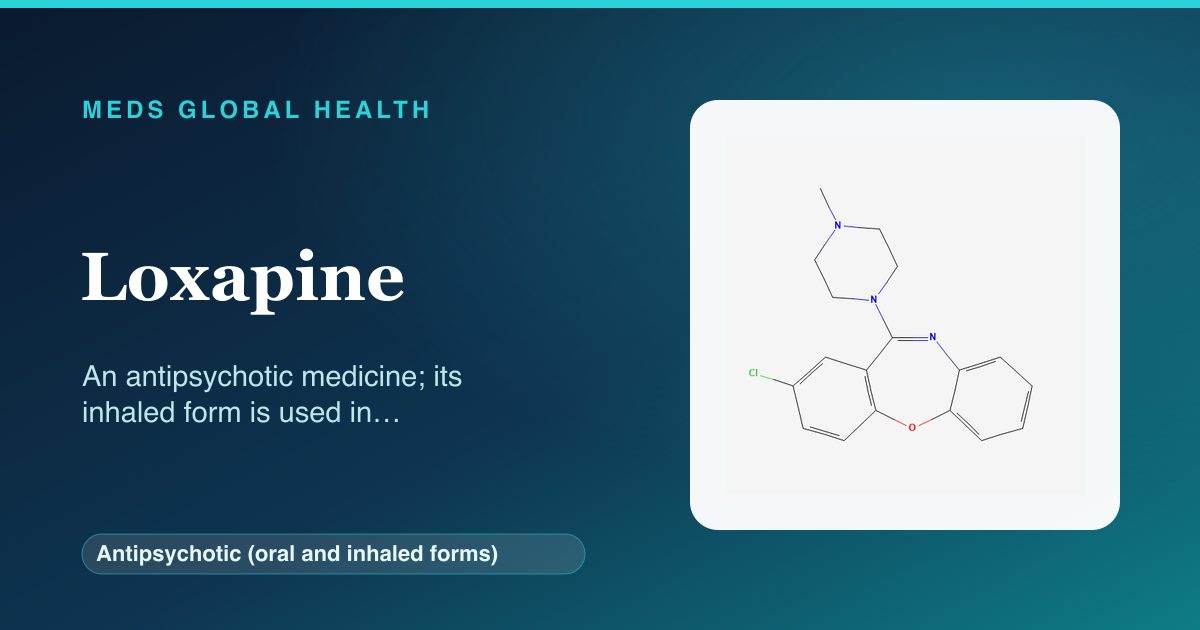
What it is
Loxapine is an antipsychotic, a type of medicine used to treat conditions such as psychosis. One notable form is an inhaled powder that a person breathes in, which is used in supervised settings — such as a hospital — to bring rapid calm to sudden agitation in people with psychosis or bipolar disorder. Because it is breathed into the lungs, it can act quickly. It is given by trained staff in a place where breathing can be watched and supported, because of a specific risk to the airways. There is also an oral form of loxapine used as a regular antipsychotic.
How it works
Loxapine works mainly by blocking dopamine signalling in the brain, which is the common way antipsychotics reduce the symptoms of psychosis and help settle agitation. The inhaled form is breathed into the lungs, where the medicine is absorbed quickly into the bloodstream, which is why it can calm agitation rapidly. That same lung route, however, is the reason for its main risk: in some people breathing the medicine in can irritate and tighten the airways (bronchospasm). This is why the inhaled form is given only in supervised settings where breathing can be monitored and treated if needed.
Company & origin
An antipsychotic medicine; an inhaled form is used in supervised settings for the rapid calming of agitation in psychosis or bipolar disorder.
What it treats
Conditions Loxapine is used for
Practical use
How to take Loxapine
General, dose-free guidance — always follow your prescriber's and the leaflet's specific instructions.
- Use the inhaled form only in a supervised setting, given by trained staff who can support breathing.
- Tell staff about any asthma, COPD or other breathing problems, as the inhaled form is avoided in these.
- Expect to be watched for a time after the inhaled dose so any airway tightening can be treated quickly.
- Take any oral form exactly as prescribed and do not change the dose yourself.
- Take care with driving or tasks needing alertness, as loxapine can cause drowsiness.
Weighing it up
Advantages & disadvantages of Loxapine
Advantages
- The inhaled form can rapidly calm sudden agitation in psychosis or bipolar disorder.
- Being breathed in, the inhaled form acts quickly without needing an injection.
- An established antipsychotic with both inhaled and oral forms.
Disadvantages
- The inhaled form can cause bronchospasm, so it is only given where breathing can be supported.
- It is avoided in people with asthma, COPD or other lung conditions.
- Like other antipsychotics, it can cause sedation and movement-related (extrapyramidal) effects.
Practical use
Good to know
The dominant safety point with the inhaled form of loxapine is the risk of bronchospasm — a sudden tightening of the airways that can make breathing difficult. For this reason it is given only in supervised settings where staff can support breathing, a reliever inhaler is kept to hand, and the person is watched for a period afterwards; it is avoided altogether in people with asthma, COPD or other lung conditions that make wheezing more likely. Like other antipsychotics, loxapine can cause drowsiness and sedation, and movement-related (extrapyramidal) effects such as restlessness, tremor or stiffness. The inhaled form is for rapid, short-term calming of agitation rather than ongoing treatment, and is used as part of a wider care plan.
Who should not take it / use with caution
- People with asthma, COPD or other breathing problems should not be given the inhaled form, because of the risk of airway tightening.
- People who have had a serious allergic reaction to loxapine should not use it.
- The inhaled form should not be used outside a supervised setting where breathing can be supported.
Monitoring
- Watching breathing closely after the inhaled dose for any sign of airway tightening.
- Checking the level of sedation and calming achieved.
- Reviewing for movement-related side effects with ongoing antipsychotic treatment.
Side effects
- Drowsiness or sedation.
- An altered or unpleasant taste after using the inhaled form.
- Movement-related effects such as restlessness, tremor or stiffness.
- Bronchospasm (tightening of the airways) with the inhaled form, which is why it is used only in supervised settings.
Key interactions
- It adds to the sedating effect of alcohol and other medicines that cause drowsiness.
- Combining it with other medicines that affect the heart rhythm or the brain needs care.
- Tell staff or your prescriber about all your medicines and any lung problems before it is used.
Available as: An inhaled powder breathed in, and tablets taken by mouth.
Answers
Loxapine: frequently asked questions
What is the inhaled form of loxapine used for?
It is used in supervised settings to rapidly calm sudden, mild-to-moderate agitation in people with psychosis or bipolar disorder.
Why must it be given in a supervised setting?
The inhaled form can cause bronchospasm, a tightening of the airways, so it is only given where staff can monitor and support breathing.
Who should not use the inhaled form?
People with asthma, COPD or other lung conditions should not be given it, because they are at greater risk of airway tightening.
Does it make you drowsy?
Yes, like other antipsychotics loxapine can cause drowsiness and sedation, so care is needed with alertness afterwards.
Is it a long-term treatment?
The inhaled form is for rapid, short-term calming of agitation; ongoing treatment uses other approaches as part of a wider care plan.
The wider class
About Antipsychotic (oral and inhaled forms)
Loxapine belongs to the antipsychotic (oral and inhaled forms) class. For how the class as a whole works, its shared safety principles and monitoring, see the full guide.
Browse by body system
Authoritative sources
- BNF
- NICE CKS
Building a medicines information resource?
We create evidence-led, dose-free drug and formulary references for teams.