A chemotherapy medicine for certain cancers
Bleomycin
A chemotherapy medicine used for some lymphomas, testicular cancer and certain other cancers, with cumulative lung damage as its key risk.
What is Bleomycin?
Bleomycin is a chemotherapy (cytotoxic) medicine used under specialist cancer care, most often as part of treatment for Hodgkin lymphoma and testicular cancer, and for some other cancers. It works by damaging the DNA of cancer cells so they cannot keep dividing. Its most important and distinctive risk is cumulative lung damage (scarring known as pulmonary fibrosis), which can build up with the total amount given, so lung function is watched closely. It commonly causes fever and chills after a dose and skin changes. High oxygen levels, such as during an anaesthetic, can worsen the lung injury, so the cancer team must always be told a patient has had bleomycin.
Education and reference only. This is a plain-language guide to Bleomycin — it deliberately contains no doses. Doses depend on the person, the brand and the reason for treatment, and belong with your prescriber. Always check the BNF, the product labelling (SmPC) and follow medical advice.
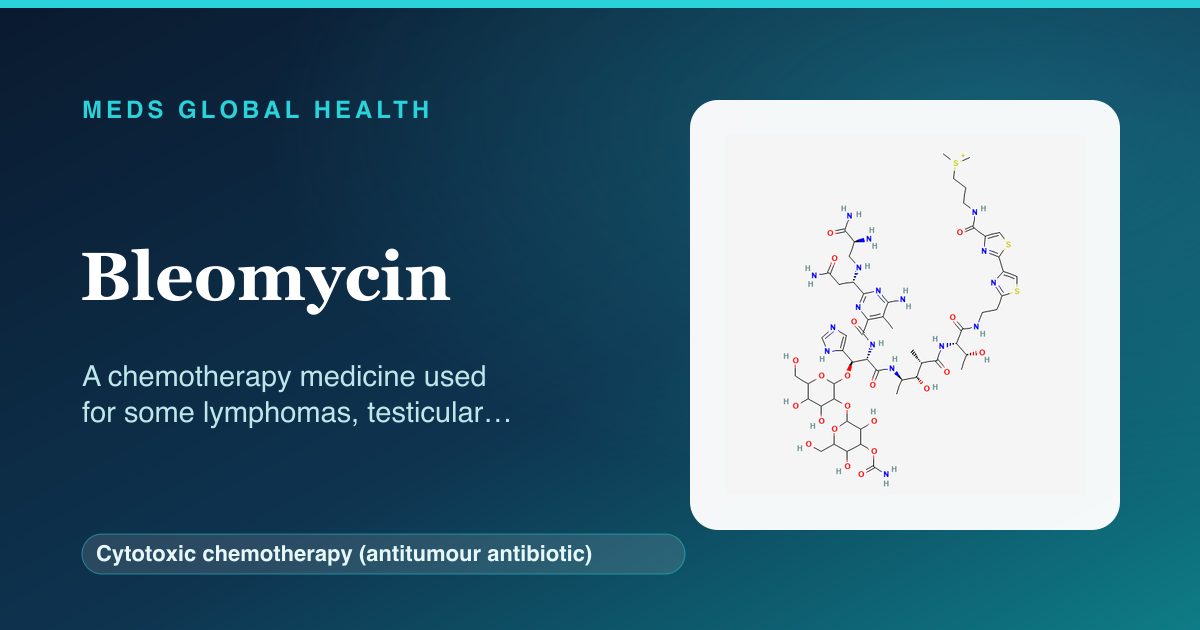
What it is
Bleomycin is a cytotoxic chemotherapy medicine, meaning it kills or stops the growth of cancer cells. It is used as part of combination chemotherapy for several cancers, particularly Hodgkin lymphoma and testicular cancer, and is sometimes used for certain other cancers and for some non-cancer uses under specialist guidance. It is given by injection, usually into a vein or muscle, by a specialist cancer team. Its best-known feature is that it can cause lung damage that adds up with the total dose received over time, which shapes how it is used and monitored.
How it works
Bleomycin works by binding to the DNA inside cancer cells and breaking it, so the cells can no longer copy themselves and divide. This damage is greatest in fast-dividing cancer cells, which slows or stops the cancer from growing. Unlike some chemotherapy, it causes relatively little bone-marrow suppression, but it can damage the lungs because lung tissue is sensitive to it, and this damage tends to build up the more bleomycin a person has had in total. This is why the team keeps a careful record of the total amount given.
Company & origin
A chemotherapy medicine used in the UK under specialist care, mainly for some lymphomas and testicular cancer and a few other cancers.
Practical use
How to take Bleomycin
General, dose-free guidance — always follow your prescriber's and the leaflet's specific instructions.
- It is given by injection by your specialist cancer team, usually as part of combination chemotherapy on a planned schedule.
- Report any new breathlessness, dry cough or chest discomfort straight away, as these can be signs of lung effects.
- Always tell any future doctor, anaesthetist or surgeon that you have had bleomycin, because extra oxygen can worsen lung injury.
- Expect that fever and chills may come on a few hours after a dose; your team will advise how to manage this.
- Keep all monitoring appointments, including breathing and lung-function checks.
Weighing it up
Advantages & disadvantages of Bleomycin
Advantages
- An important part of curative chemotherapy for Hodgkin lymphoma and testicular cancer.
- Causes relatively little bone-marrow suppression compared with many chemotherapy medicines.
- Well-established with decades of experience guiding its safe use.
Disadvantages
- Can cause cumulative lung damage (pulmonary fibrosis) that builds up with the total dose.
- Commonly causes fever and chills after a dose, and skin changes such as darkening or thickening.
- High oxygen levels, such as during an anaesthetic, can worsen the lung injury.
Practical use
Good to know
The single most important thing to understand about bleomycin is its effect on the lungs: it can cause lung scarring (pulmonary fibrosis) that builds up with the total dose received, so the cancer team monitors breathing and lung function and will stop the medicine if signs appear. Any new breathlessness, a dry cough or chest discomfort should be reported straight away. A crucial safety point is that high oxygen levels can worsen this lung injury, so anyone who has had bleomycin should make sure any future anaesthetist or doctor knows about it, as oxygen given during surgery may need to be limited. It also commonly causes fever and chills a few hours after a dose, and can cause skin changes such as darkening, thickening or rashes. It is always given and monitored by a specialist cancer team.
Who should not take it / use with caution
- People who have had a serious allergic reaction to bleomycin should not receive it.
- It is used with great caution, or avoided, in people with significant existing lung disease.
- It is not suitable in pregnancy and is given only under specialist cancer care, with careful dose tracking.
Monitoring
- Regular checks of breathing and lung function to catch lung damage early.
- Keeping a careful record of the total amount of bleomycin given over time.
- Reviewing skin, temperature and general response to treatment at each cycle.
Side effects
- Lung effects such as breathlessness and a dry cough from scarring (pulmonary fibrosis), which can build up over time.
- Fever and chills, often a few hours after a dose.
- Skin changes such as darkening, thickening, rashes or sore areas, and hair thinning.
- Mouth soreness and, less often, allergic-type reactions.
Key interactions
- High oxygen levels, including oxygen given during surgery, can worsen bleomycin lung damage, so all future doctors must be told.
- It is given alongside other chemotherapy medicines, whose combined effects the team manages.
- Tell your team about all your medicines, as some can affect the kidneys, which influences how bleomycin is handled.
Available as: A powder made up into a solution for injection, usually into a vein or muscle, given by a specialist team.
Answers
Bleomycin: frequently asked questions
What is bleomycin used for?
It is a chemotherapy medicine used, usually in combination, to treat cancers such as Hodgkin lymphoma and testicular cancer, and some other cancers, under specialist care.
Why is it bad for the lungs?
Bleomycin can cause lung scarring (pulmonary fibrosis) that tends to build up with the total dose received, so your team monitors your breathing and lung function closely.
Why must I tell future doctors I have had it?
High oxygen levels, such as those given during an anaesthetic, can worsen bleomycin lung injury, so any anaesthetist or surgeon needs to know you have had it.
Why do I get fever and chills after a dose?
Fever and chills a few hours after a dose are a common reaction to bleomycin; your cancer team will advise how to manage them.
Will it make my hair fall out?
It can cause some hair thinning and skin changes such as darkening or thickening; your team can advise on what to expect and how to cope.
The wider class
About Cytotoxic chemotherapy (antitumour antibiotic)
Bleomycin belongs to the cytotoxic chemotherapy (antitumour antibiotic) class. For how the class as a whole works, its shared safety principles and monitoring, see the full guide.
Browse by body system
Authoritative sources
- BNF
- NICE CKS
Building a medicines information resource?
We create evidence-led, dose-free drug and formulary references for teams.