A taxane chemotherapy
Paclitaxel
A taxane chemotherapy given by drip for breast, ovarian and lung cancers, among others.
What is Paclitaxel?
Paclitaxel is a chemotherapy medicine from the taxane group, given as a drip into a vein to treat cancers such as breast, ovarian and lung cancer. It works by stopping cancer cells from dividing, but it also affects some healthy cells, which is why it can lower your blood counts, thin your hair and cause numbness or tingling in the hands and feet. Because it can trigger an allergic reaction during the infusion, you are usually given pre-medication beforehand. A fever or feeling unwell must always be reported urgently, as a low white-cell count can make infections dangerous.
Education and reference only. This is a plain-language guide to Paclitaxel — it deliberately contains no doses. Doses depend on the person, the brand and the reason for treatment, and belong with your prescriber. Always check the BNF, the product labelling (SmPC) and follow medical advice.
What it is
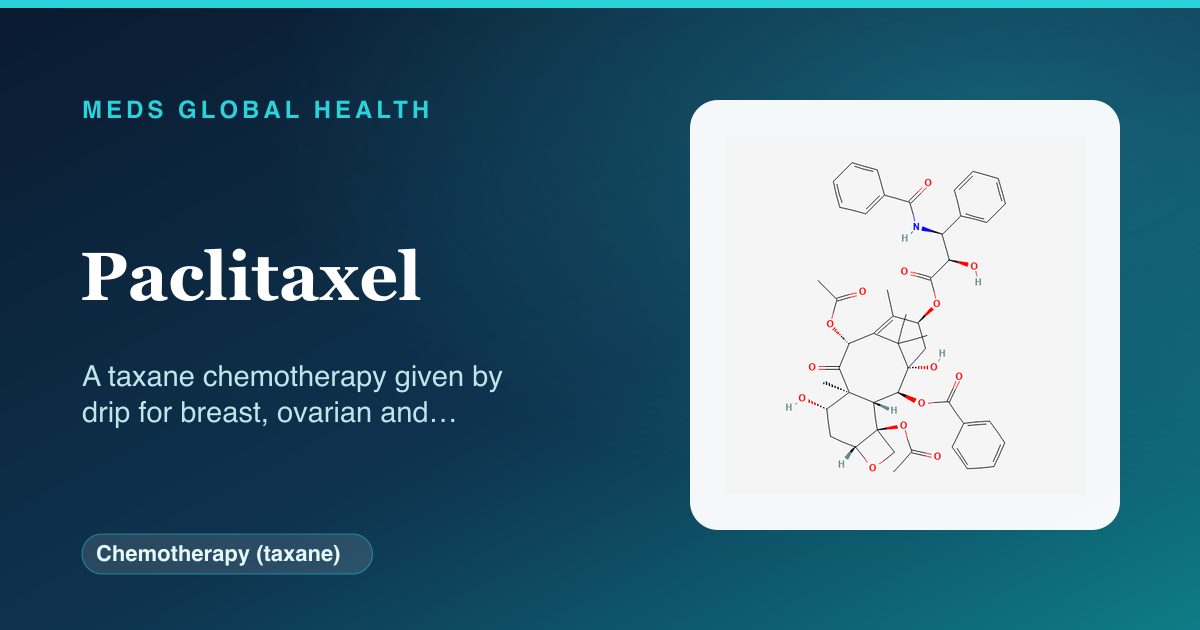
Paclitaxel is a cancer chemotherapy belonging to the taxane group. It is given as an infusion (a drip) into a vein, usually in a chemotherapy day unit, as part of a planned course over several cycles. It is used for a range of cancers, including breast, ovarian and lung cancer, sometimes on its own and sometimes alongside other treatments. There are different formulations, including a standard form and one bound to a protein (Abraxane), which are used in slightly different situations. Treatment is always started and supervised by a cancer specialist.
How it works
Paclitaxel works inside cells on the tiny internal scaffolding (microtubules) that cells need in order to divide. By freezing this scaffolding in place, it stops cancer cells from splitting into new cells, which slows or shrinks the cancer. Because some fast-growing healthy cells — such as those in the bone marrow, hair and the lining of the gut — divide in a similar way, they can be affected too, which explains many of the side effects. The aim is to harm the cancer cells more than the healthy ones, and the healthy tissues usually recover between cycles.
Company & origin
A taxane chemotherapy given as a drip in UK cancer units to treat several common cancers, started and supervised by a cancer specialist.
Practical use
How to take Paclitaxel
General, dose-free guidance — always follow your prescriber's and the leaflet's specific instructions.
- It is given by a nurse as a drip into a vein in a chemotherapy unit; you do not take it at home.
- You will usually be given pre-medication before the infusion to lower the chance of an allergic reaction.
- Tell the nurse straight away if you feel flushed, breathless, dizzy or develop a rash during the drip, as reactions are most likely early on.
- Keep your chemotherapy helpline number with you and ring it at once if you feel feverish or unwell between treatments.
- Go to your blood tests before each cycle, as treatment may be delayed if your counts have not recovered.
Weighing it up
Advantages & disadvantages of Paclitaxel
Advantages
- An effective, well-established chemotherapy used across several common cancers.
- Can be combined with other cancer treatments as part of a planned programme.
- Side effects on healthy tissues, such as blood counts and hair, usually recover after treatment ends.
Disadvantages
- Lowers blood counts, raising the risk of infection, bleeding and anaemia.
- Often causes nerve symptoms (numbness and tingling) and hair loss.
- Can cause allergic reactions during the infusion, so close monitoring and pre-medication are needed.
Practical use
Good to know
The most important thing to watch for is infection. Paclitaxel lowers the white blood cells that fight infection, so a temperature, shivering, a sore throat or simply feeling very unwell — especially a few days to a couple of weeks after a treatment — can be a sign of neutropenic sepsis, which is a medical emergency. Do not wait; contact your chemotherapy helpline straight away, at any hour. Numbness, tingling or pins and needles in the hands and feet (peripheral neuropathy) is common and may build up over the course, so report it early as the dose can be adjusted. Hair loss is common but usually grows back after treatment finishes. Because the drug itself, or the substance it is dissolved in, can cause an allergic reaction during the drip, you are given pre-medication (such as steroids and antihistamines) beforehand, and you will be watched closely, especially during the first infusions. Chemotherapy can affect fertility, so talk to your team about this before starting; avoid becoming pregnant or fathering a child during treatment, and avoid live vaccines.
Who should not take it / use with caution
- People who have had a serious allergic reaction to paclitaxel or the substance it is dissolved in.
- It is generally not started when blood counts are too low or a serious infection is present, until these are sorted.
- It is avoided in pregnancy and breastfeeding, and used with care in significant liver problems or existing nerve damage.
Monitoring
- Regular blood tests before each cycle to check blood counts and organ function.
- Checking for nerve symptoms so the dose can be adjusted if numbness or tingling builds up.
- Watching closely during infusions for signs of an allergic reaction.
Side effects
- Low blood counts (raising the risk of infection, bruising, bleeding and tiredness from anaemia) — report fever urgently.
- Numbness or tingling in the hands and feet, hair loss, muscle and joint aches, and nausea.
- Allergic reactions during the drip, mouth soreness, diarrhoea, and changes to the nails.
Key interactions
- Medicines that affect the same liver enzymes (such as some antifungals and certain antibiotics) can change paclitaxel levels.
- Other treatments that lower blood counts add to the risk, so the whole programme is planned together.
- Live vaccines should be avoided; tell your team about all medicines, including over-the-counter and herbal products such as St John's wort.
Available as: An infusion (drip) into a vein, given in a chemotherapy unit.
Answers
Paclitaxel: frequently asked questions
Why am I given other medicines before the drip?
The pre-medication, such as a steroid and an antihistamine, lowers the chance of an allergic reaction to paclitaxel during the infusion, which is most likely in the first treatments.
Will I lose my hair?
Hair loss is common with paclitaxel, but it is usually temporary and hair generally grows back after treatment finishes; your team can discuss scalp cooling.
What should I do if I get a temperature?
Treat it as urgent. A fever can mean a serious infection because your white cells are low, so ring your chemotherapy helpline straight away at any time of day or night.
Why do my hands and feet feel numb or tingly?
This is peripheral neuropathy, a known effect of paclitaxel on the nerves; tell your team early, as the dose can sometimes be adjusted to stop it getting worse.
Can I have my flu jab during treatment?
The inactivated flu jab is usually fine and often recommended, but live vaccines must be avoided; always check with your cancer team first.
The wider class
About Chemotherapy (taxane)
Paclitaxel belongs to the chemotherapy (taxane) class. For how the class as a whole works, its shared safety principles and monitoring, see the full guide.
Browse by body system
Authoritative sources
- BNF
- NICE CKS
Building a medicines information resource?
We create evidence-led, dose-free drug and formulary references for teams.