An oral chemotherapy for brain tumours
Temozolomide
An oral chemotherapy used to treat certain brain tumours, such as glioma, often given with radiotherapy.
What is Temozolomide?
Temozolomide is a chemotherapy taken by mouth as capsules, used to treat certain brain tumours such as glioma, often together with radiotherapy. It works by damaging the DNA of cancer cells so they cannot keep growing. Its most important effect is suppression of the bone marrow, lowering blood counts and raising the risk of infection, bleeding and anaemia. Nausea is common, so anti-sickness medicine is given with it, and because it weakens the immune system, treatment to prevent a lung infection called Pneumocystis pneumonia is often needed.
Education and reference only. This is a plain-language guide to Temozolomide — it deliberately contains no doses. Doses depend on the person, the brand and the reason for treatment, and belong with your prescriber. Always check the BNF, the product labelling (SmPC) and follow medical advice.
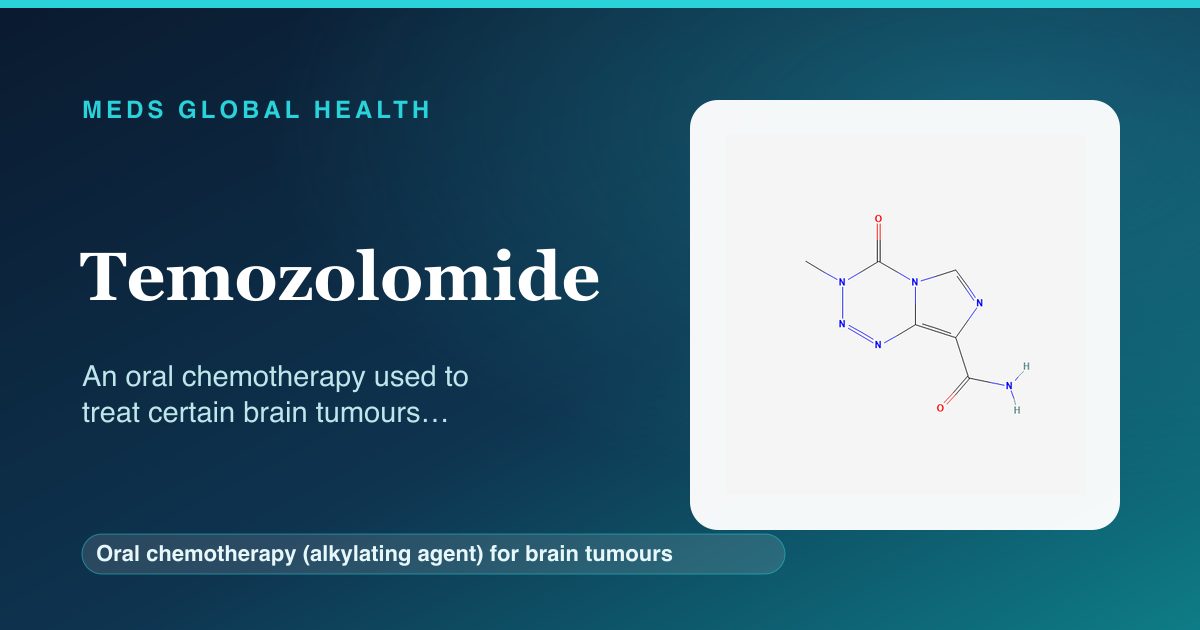
What it is
Temozolomide is a chemotherapy medicine, but unlike many it is taken by mouth as capsules rather than given by drip. It is used to treat certain brain tumours, particularly a type called glioma, and is often given alongside radiotherapy and then in cycles afterwards. As a cancer treatment, it is prescribed and closely supervised by a cancer specialist (oncologist) and their team, who plan the timing, supportive medicines and blood tests around it. It is a powerful treatment that needs careful handling and monitoring.
How it works
Temozolomide works by adding chemical changes to the DNA inside cancer cells, which damages it so the cells can no longer divide and grow properly, and they eventually die. Because it can reach the brain, it is useful against brain tumours such as glioma, and it is often combined with radiotherapy, which damages cancer cells in a complementary way. The downside is that it also affects fast-growing healthy cells, especially those in the bone marrow that make blood cells, which is why it lowers blood counts and needs regular monitoring.
Company & origin
A specialist oral chemotherapy used in the UK to treat certain brain tumours, such as glioma, often alongside radiotherapy.
Practical use
How to take Temozolomide
General, dose-free guidance — always follow your prescriber's and the leaflet's specific instructions.
- Take the capsules whole with water, exactly as prescribed, without opening or crushing them.
- Take your anti-sickness medicine as advised, and take temozolomide at a consistent time, often on an empty stomach.
- Attend all your blood tests so your blood counts can be checked closely.
- Take any medicine prescribed to prevent Pneumocystis pneumonia for as long as your team advises.
- Report any fever, signs of infection, unusual bruising or bleeding straight away, and use reliable contraception.
Weighing it up
Advantages & disadvantages of Temozolomide
Advantages
- Treats certain brain tumours, such as glioma, and can be taken by mouth at home.
- Reaches the brain and works well alongside radiotherapy.
- Allows treatment in cycles, planned and supported by the cancer team.
Disadvantages
- Suppresses the bone marrow, lowering blood counts and raising the risk of infection, bleeding and anaemia.
- Commonly causes nausea, needing anti-sickness medicine, and can cause tiredness.
- Weakens the immune system, so extra treatment to prevent Pneumocystis pneumonia is often needed.
Practical use
Good to know
The dominant safety issue is its effect on the bone marrow: temozolomide lowers the production of blood cells, which can cause a higher risk of infection, a tendency to bruise or bleed, and tiredness from anaemia, so blood counts are checked closely and any fever or signs of infection must be reported urgently. Nausea is common, which is why anti-sickness medicine is given before and with it, and the capsules are usually taken at a consistent time, often on an empty stomach. Because it weakens the immune system, your team will often prescribe treatment to prevent a particular lung infection called Pneumocystis pneumonia. The capsules are cytotoxic and must be swallowed whole and handled carefully, never opened or crushed. Effective contraception is needed, as it can harm a developing baby.
Who should not take it / use with caution
- People who have had a serious allergic reaction to temozolomide should not take it.
- It is not suitable in pregnancy, as it can harm a developing baby, so reliable contraception is essential.
- It is used with caution, and with dose adjustment or delay, in people with very low blood counts or significant liver problems.
Monitoring
- Regular blood tests to check blood counts before and during each cycle.
- Monitoring liver function and overall wellbeing.
- Watching for signs of infection, bleeding, and the response of the tumour on scans over time.
Side effects
- Low blood counts, raising the risk of infection, bruising, bleeding and anaemia.
- Nausea and vomiting, usually managed with anti-sickness medicine.
- Tiredness, constipation, headache or loss of appetite.
- A risk of serious infection, including Pneumocystis pneumonia, which preventive treatment helps guard against.
Key interactions
- Other medicines that lower blood counts can add to the effect on the bone marrow.
- Live vaccines are generally avoided because the immune system is weakened.
- Tell your team about all medicines, supplements and herbal remedies so interactions can be checked.
Available as: Capsules taken by mouth.
Answers
Temozolomide: frequently asked questions
What is temozolomide used for?
It is an oral chemotherapy used to treat certain brain tumours, such as glioma, often alongside radiotherapy and then in cycles.
Why are my blood counts checked so often?
Temozolomide suppresses the bone marrow, lowering blood cells, so counts are checked closely to manage the risk of infection, bleeding and anaemia.
Why do I need anti-sickness medicine?
Nausea is common with temozolomide, so anti-sickness medicine is given before and with it to help prevent and control sickness.
What is the medicine to prevent a lung infection?
Because it weakens the immune system, your team often prescribes treatment to prevent Pneumocystis pneumonia, a lung infection that can affect people with low immunity.
How should I take and handle the capsules?
Swallow them whole with water, without opening or crushing them, take them at a consistent time as advised, and handle them carefully as they are cytotoxic.
The wider class
About Oral chemotherapy (alkylating agent) for brain tumours
Temozolomide belongs to the oral chemotherapy (alkylating agent) for brain tumours class. For how the class as a whole works, its shared safety principles and monitoring, see the full guide.
Browse by body system
Authoritative sources
- BNF
- NICE CKS
Building a medicines information resource?
We create evidence-led, dose-free drug and formulary references for teams.