Also called actinomycin D
Dactinomycin
A chemotherapy medicine used mainly for some childhood cancers and gestational trophoblastic disease.
What is Dactinomycin?
Dactinomycin, also called actinomycin D, is a chemotherapy medicine used mainly to treat certain childhood cancers, such as Wilms' tumour (a kidney cancer) and rhabdomyosarcoma, and a pregnancy-related cancer called gestational trophoblastic disease. It is given into a vein under specialist cancer care. Its main risks are a drop in blood cells (bone-marrow suppression), severe tissue damage if it leaks out of the vein (it is a vesicant), and 'radiation recall', where skin that has had radiotherapy flares up again. It is always given by a specialist team.
Education and reference only. This is a plain-language guide to Dactinomycin — it deliberately contains no doses. Doses depend on the person, the brand and the reason for treatment, and belong with your prescriber. Always check the BNF, the product labelling (SmPC) and follow medical advice.
What it is
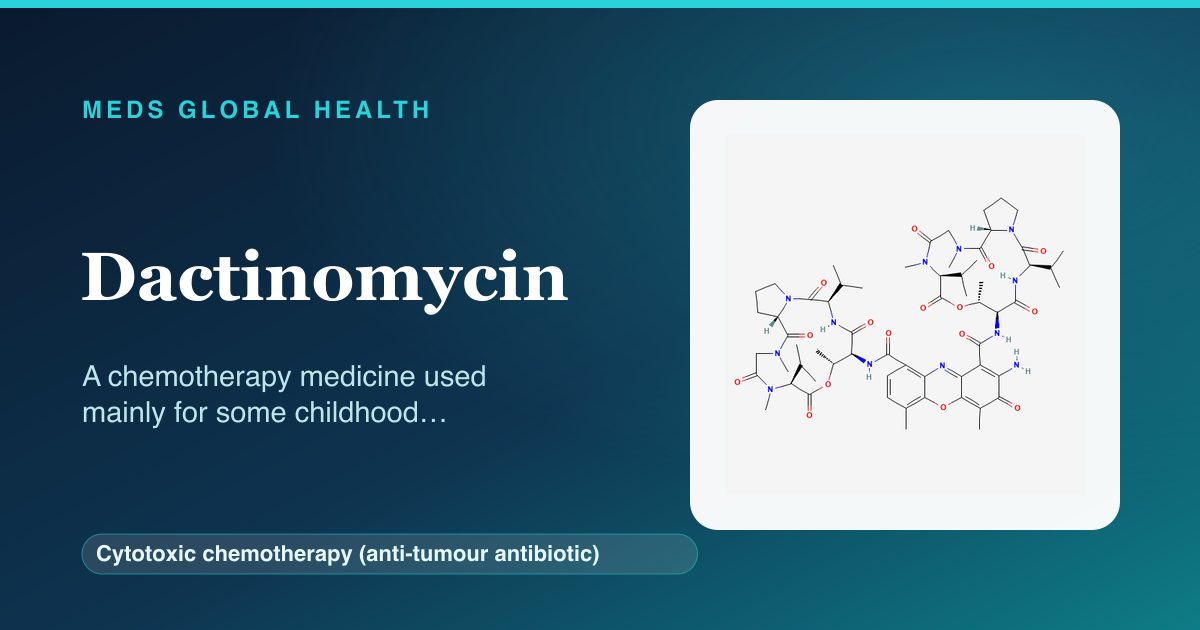
Dactinomycin, also known as actinomycin D, is a chemotherapy medicine in a group called anti-tumour antibiotics. It is used mainly to treat some cancers that occur in children, such as Wilms' tumour (a cancer of the kidney) and rhabdomyosarcoma (a cancer of soft tissue), as well as gestational trophoblastic disease, a cancer that can develop from tissue related to pregnancy. It is given into a vein, usually as part of a combination of treatments, and is always used under the care of a specialist cancer team.
How it works
Dactinomycin works by attaching to the cell's DNA and blocking the steps cancer cells need to copy themselves and grow, so the cancer cells die. Because it acts on fast-dividing cells, it also affects some healthy cells that divide quickly, such as those in the bone marrow, the gut lining and the hair, which explains many of its side effects. It is given into a vein, carefully, because it can cause serious damage if it leaks into the surrounding tissue. It is usually one part of a planned course combined with other treatments.
Company & origin
A specialist chemotherapy medicine used in the UK mainly for certain childhood cancers and a pregnancy-related cancer.
Practical use
How to take Dactinomycin
General, dose-free guidance — always follow your prescriber's and the leaflet's specific instructions.
- It is given into a vein by a specialist cancer team, as part of a planned treatment course.
- Report any pain, swelling, redness or burning at the drip site straight away, as the medicine can damage tissue if it leaks.
- Contact your team urgently if you develop a fever or feel unwell, as this can signal a serious infection.
- Attend all blood-test and treatment appointments so your blood counts can be checked.
- Tell your team about any previous radiotherapy, as treated skin can flare up again.
Weighing it up
Advantages & disadvantages of Dactinomycin
Advantages
- An effective chemotherapy for certain childhood cancers and gestational trophoblastic disease.
- Often used as part of combination treatment that can be highly effective for these cancers.
- Given by experienced specialist teams who manage its risks closely.
Disadvantages
- Lowers blood cells, raising the risk of infection, anaemia and bleeding.
- Causes severe tissue damage if it leaks out of the vein during the infusion.
- Can cause nausea, mouth soreness, hair loss and 'radiation recall' in previously treated skin.
Practical use
Good to know
Several safety points dominate with dactinomycin, and the specialist team manages all of them closely. The most important is bone-marrow suppression: the medicine lowers the blood cells that fight infection, carry oxygen and help clotting, so blood counts are checked and any fever or sign of infection must be treated as an emergency. It is also a vesicant, meaning it causes severe damage if it leaks out of the vein during the infusion, so it is given very carefully and any pain, swelling or burning at the drip site must be reported straight away. A further effect is 'radiation recall', where skin that has previously had radiotherapy can become red and inflamed again. Nausea, mouth soreness and hair loss are also common. Because it affects fast-dividing cells, it is given only by experienced cancer teams.
Who should not take it / use with caution
- People who have had a serious allergic reaction to dactinomycin should not receive it.
- It is generally avoided in pregnancy and breastfeeding because of the risk to the baby.
- It is used with great care, or avoided, in people with severe infections or very low blood counts, as judged by the specialist team.
Monitoring
- Regular blood tests to check blood counts before and during treatment.
- Watching the drip site closely during the infusion for any sign of leakage.
- Checking liver function and general wellbeing over the course of treatment.
Side effects
- A drop in blood cells, raising the risk of infection, tiredness from anaemia, and bruising or bleeding.
- Nausea and vomiting, soreness of the mouth, and hair loss.
- Severe damage to tissue if the medicine leaks out of the vein.
- 'Radiation recall', where skin that has had radiotherapy becomes red and inflamed again, and, rarely, liver problems.
Key interactions
- It is used carefully alongside radiotherapy, which can increase skin and other reactions.
- Other medicines that lower blood cells or affect the immune system add to its effects.
- Tell your team about all your medicines, including vaccines, as live vaccines are generally avoided during treatment.
Available as: A powder made up into a solution given into a vein.
Answers
Dactinomycin: frequently asked questions
What is dactinomycin used for?
It is a chemotherapy used mainly for certain childhood cancers, such as Wilms' tumour and rhabdomyosarcoma, and for gestational trophoblastic disease, a pregnancy-related cancer.
Is dactinomycin the same as actinomycin D?
Yes, dactinomycin is also called actinomycin D; they are two names for the same medicine.
Why is the drip site watched so closely?
Dactinomycin is a vesicant, meaning it can cause severe tissue damage if it leaks out of the vein, so any pain, swelling or burning at the site must be reported straight away.
Why do my blood counts need checking?
It lowers the blood cells that fight infection, carry oxygen and help clotting, so blood tests are used to monitor this and any fever must be treated as an emergency.
What is 'radiation recall'?
It is a reaction where skin that has previously had radiotherapy becomes red and inflamed again during chemotherapy, so tell your team about any past radiotherapy.
The wider class
About Cytotoxic chemotherapy (anti-tumour antibiotic)
Dactinomycin belongs to the cytotoxic chemotherapy (anti-tumour antibiotic) class. For how the class as a whole works, its shared safety principles and monitoring, see the full guide.
Browse by body system
Authoritative sources
- BNF
- NICE CKS
Building a medicines information resource?
We create evidence-led, dose-free drug and formulary references for teams.