An anthracycline chemotherapy medicine
Doxorubicin
A widely used red-coloured chemotherapy infusion, given under specialist care, for many cancers, with careful heart monitoring.
What is Doxorubicin?
Doxorubicin is a chemotherapy medicine given by drip (infusion) in hospital under cancer-team care, used for many cancers such as breast cancer, lymphomas and sarcomas. It is bright red, which is why it is sometimes nicknamed 'the red devil', and it can turn your urine red or orange for a day or two, which is completely harmless. An important point is that it can affect the heart, so there is a lifetime limit on the total amount you can have and your heart may be checked before and during treatment. It can cause serious damage if it leaks from the vein, and like all chemotherapy it causes mouth soreness, low blood counts, hair loss and a raised infection risk.
Education and reference only. This is a plain-language guide to Doxorubicin — it deliberately contains no doses. Doses depend on the person, the brand and the reason for treatment, and belong with your prescriber. Always check the BNF, the product labelling (SmPC) and follow medical advice.
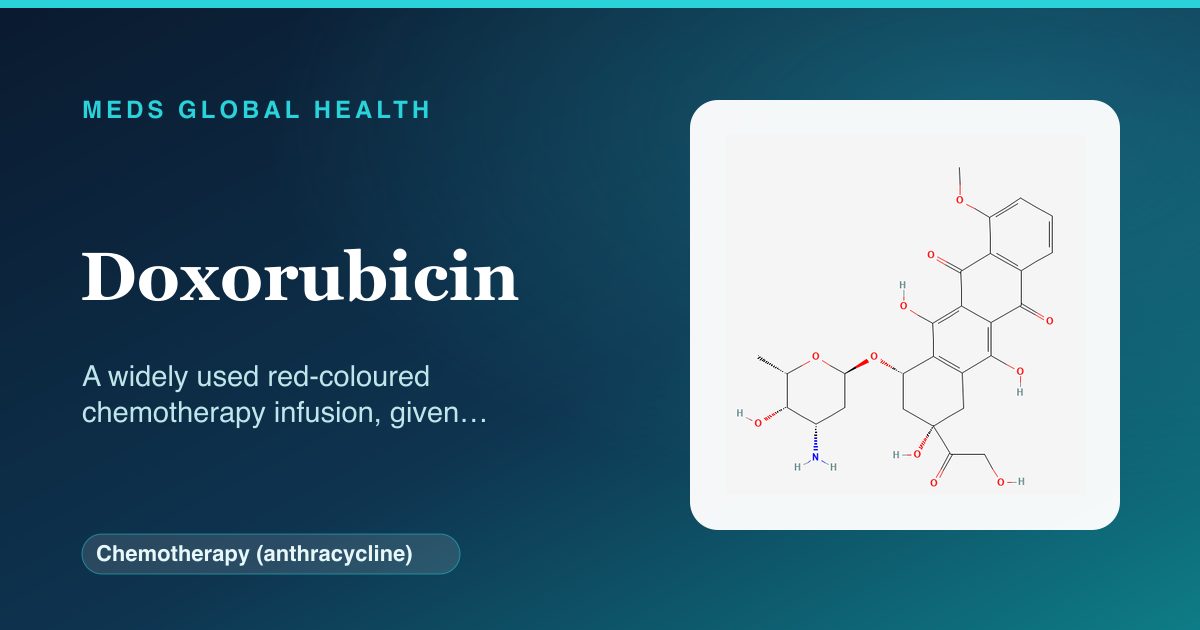
What it is
Doxorubicin is a cytotoxic chemotherapy medicine from the 'anthracycline' family, given by injection or drip in hospital for a wide range of cancers, including breast cancer, lymphomas, leukaemias and sarcomas. It is a striking red colour, which has earned it the nickname 'the red devil', and is always given and supervised by an oncology team, often combined with other chemotherapy. There are also special 'liposomal' versions (such as Caelyx and Myocet) that package the medicine to change how it behaves in the body. Treatment is given in cycles with recovery periods.
How it works
Doxorubicin works its way into the DNA of cancer cells and jams the machinery they use to copy and repair their genetic material, so the cells cannot keep dividing and many die. Because it also affects healthy fast-dividing cells, it causes mouth soreness, hair loss and low blood counts. Its effect on the heart muscle builds up with the total amount received over a lifetime, which is why a cumulative limit is set and the heart is monitored. The red colour passes harmlessly into the urine for a short time after each dose.
Company & origin
A long-established chemotherapy medicine used in the UK, under specialist care, for many cancers including breast cancer and lymphoma.
Practical use
How to take Doxorubicin
General, dose-free guidance — always follow your prescriber's and the leaflet's specific instructions.
- It is given by drip or injection in hospital by your cancer team, on a planned schedule of cycles.
- Tell the nurses immediately if you feel stinging, burning, pain or swelling at the drip site during the infusion.
- Do not be alarmed if your urine turns red or orange for a day or two afterwards — this is harmless.
- Look after your mouth with gentle care and report soreness, and keep all your heart-check appointments.
- Contact your team's emergency line straight away if you develop a fever, shivering or feel suddenly unwell.
Weighing it up
Advantages & disadvantages of Doxorubicin
Advantages
- A powerful, effective treatment used across many different cancers, often as a key part of combination therapy.
- Long experience means its effects, including its impact on the heart, are well understood and carefully managed.
- Special liposomal versions can be used in certain situations to alter the pattern of side effects.
Disadvantages
- Can affect the heart, so there is a lifetime limit on total dose and heart monitoring is needed.
- Causes serious tissue damage if it leaks from the vein, and like all chemotherapy lowers blood counts and raises infection risk.
- Commonly causes mouth soreness, nausea and hair loss.
Practical use
Good to know
Two things often surprise people and are worth knowing in advance: your urine may turn red or orange for a day or two after treatment, which is harmless and simply the colour of the medicine passing through; and the drug can cause serious tissue damage if it leaks out of the vein during the infusion, so tell the nurses immediately if you feel any stinging, burning or swelling at the drip site. The most important long-term consideration is the heart — because the effect builds up over time, there is a lifetime limit on the total dose, and your heart function is usually checked before and during treatment, with care taken if you already have heart problems. As with all chemotherapy, it lowers blood counts, so a fever or feeling suddenly unwell is a medical emergency (possible neutropenic sepsis) — ring your team's emergency line at once. Mouth soreness, nausea and hair loss are common; anti-sickness medicines are given and hair usually regrows after treatment. Pregnancy must be avoided and contraception used, fertility can be affected, and live vaccines avoided. It is completely normal to feel anxious — your team is there to help, so please share any worries.
Who should not take it / use with caution
- It is generally avoided in people with significant existing heart failure or recent serious heart problems.
- It is avoided in pregnancy and breastfeeding because it can harm a developing baby.
- People who have already received the maximum lifetime dose of an anthracycline are not given more, to protect the heart.
Monitoring
- Heart function is usually checked before and during treatment, with the total lifetime dose tracked carefully.
- Regular blood tests to check blood counts and kidney and liver function during treatment.
- Reviewing mouth soreness, nausea and other side effects at each cycle, with care of the drip site.
Side effects
- Nausea, mouth soreness, hair loss, tiredness and harmless red-coloured urine for a day or two are common.
- Low blood counts can cause infections, bruising, bleeding and anaemia — a fever or feeling very unwell needs urgent care.
- Less commonly, effects on the heart, and rarely serious tissue damage if the medicine leaks from the vein.
Key interactions
- Live vaccines are avoided during treatment, as the weakened immune system cannot handle them safely.
- Other medicines that can affect the heart may add to the cardiac risk, so your team reviews these carefully.
- It can interact with some other chemotherapy and medicines that change how it is processed, affecting side effects.
Available as: Injection or infusion given in hospital, including liposomal versions; all supervised by a specialist.
Answers
Doxorubicin: frequently asked questions
Why is my urine red after treatment?
Doxorubicin is a bright red medicine, and it can colour your urine red or orange for a day or two after each dose; this is completely harmless.
Why is it called 'the red devil'?
It is a nickname some people use because the medicine is a striking red colour; it is a powerful and effective chemotherapy given carefully by your cancer team.
Why does my heart need checking?
Doxorubicin can affect the heart muscle, and the effect builds up with the total amount received, so there is a lifetime dose limit and your heart function is monitored before and during treatment.
What should I do if the drip site stings during treatment?
Tell the nurses immediately, because the medicine can cause serious tissue damage if it leaks out of the vein, and they will act quickly.
What should I do if I get a temperature?
Treat it as an emergency. A fever or feeling suddenly unwell can mean a serious infection (neutropenic sepsis), so ring your team's emergency line straight away.
The wider class
About Chemotherapy (anthracycline)
Doxorubicin belongs to the chemotherapy (anthracycline) class. For how the class as a whole works, its shared safety principles and monitoring, see the full guide.
Browse by body system
Authoritative sources
- BNF
- NICE CKS
Building a medicines information resource?
We create evidence-led, dose-free drug and formulary references for teams.