An alkylating chemotherapy for leukaemia and transplant conditioning
Busulfan
A chemotherapy medicine used in some leukaemias and to prepare the body for a stem-cell transplant.
What is Busulfan?
Busulfan is an alkylating chemotherapy medicine used in certain leukaemias and, at high dose, to prepare (condition) the body before a stem-cell or bone-marrow transplant. It works by damaging the DNA of fast-dividing cells. Its dominant risks are severe and prolonged suppression of the bone marrow (lowering blood cells), seizures (so anti-seizure cover is given with high-dose treatment), lung scarring (fibrosis), and a serious liver problem called veno-occlusive disease. It is a specialist medicine given under close supervision with regular blood tests and monitoring.
Education and reference only. This is a plain-language guide to Busulfan — it deliberately contains no doses. Doses depend on the person, the brand and the reason for treatment, and belong with your prescriber. Always check the BNF, the product labelling (SmPC) and follow medical advice.
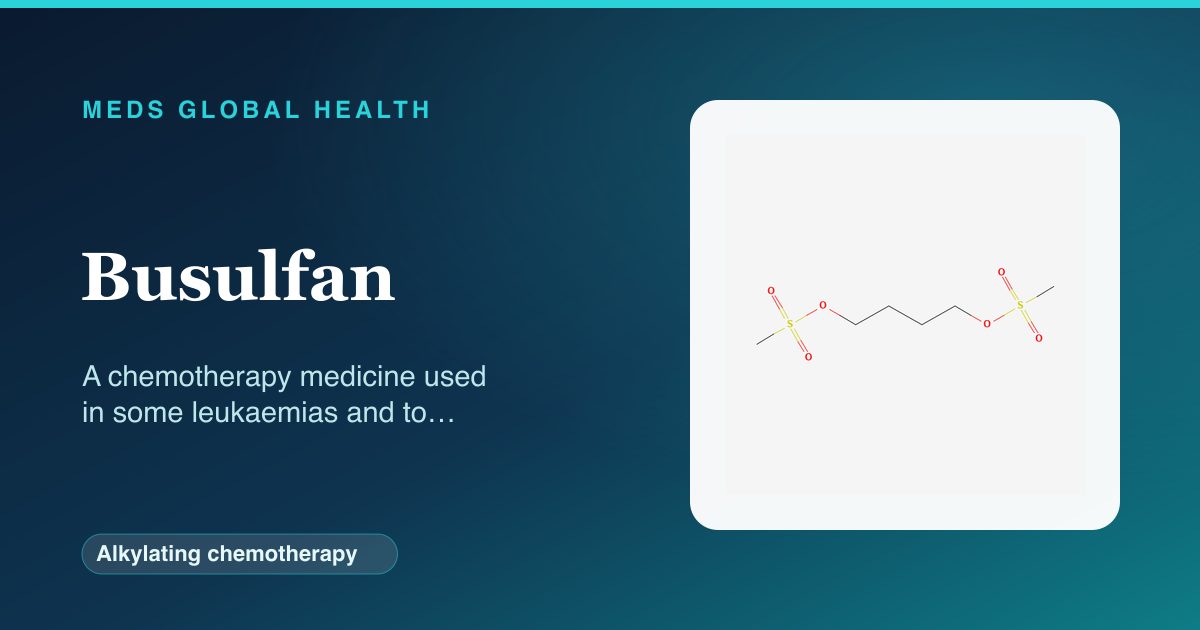
What it is
Busulfan is a type of chemotherapy known as an alkylating agent, which damages the DNA inside cells so they cannot keep dividing. It is used in certain leukaemias and, particularly at high dose, as part of the conditioning treatment that prepares the body before a stem-cell or bone-marrow transplant by clearing out the existing marrow. It is a powerful, specialist medicine given only by cancer and transplant teams in hospital, with intensive monitoring and supportive care around it.
How it works
Busulfan attaches chemical groups to the DNA of cells, damaging it so that cells which divide quickly, including bone-marrow and cancer cells, can no longer multiply and die off. In leukaemia this helps control the disease, and in transplant conditioning the high-dose treatment deliberately wipes out the existing bone marrow to make room for the new stem cells. Because it hits the bone marrow hard, it causes a deep and prolonged drop in blood cells, which is expected as part of how it works but needs careful management.
Company & origin
An alkylating chemotherapy medicine used in the UK in certain leukaemias and to prepare the body for a stem-cell (bone-marrow) transplant.
Practical use
How to take Busulfan
General, dose-free guidance — always follow your prescriber's and the leaflet's specific instructions.
- It is given only by a specialist cancer or transplant team, by mouth or into a vein, exactly as prescribed.
- Expect frequent blood tests, as it causes a deep and prolonged drop in blood cells that must be watched closely.
- Take the anti-seizure medicine given alongside high-dose treatment exactly as directed, as it is there to prevent fits.
- Report new breathlessness or a persistent cough, as the lungs can be affected over time.
- Report fever, signs of infection, unusual bruising or bleeding, or yellowing of the skin or eyes straight away.
Weighing it up
Advantages & disadvantages of Busulfan
Advantages
- An effective chemotherapy for certain leukaemias.
- A key part of conditioning treatment that prepares the body for a stem-cell or bone-marrow transplant.
- Can be given by mouth or into a vein, with the dose carefully tailored by the specialist team.
Disadvantages
- Causes severe and prolonged bone-marrow suppression, raising the risk of infection, anaemia and bleeding.
- Can cause seizures at high dose, lung scarring (fibrosis) and a serious liver problem (veno-occlusive disease).
- Carries long-term risks including effects on fertility and a small risk of second cancers, needing specialist supervision.
Practical use
Good to know
Busulfan is a powerful chemotherapy with several dominant, serious effects that shape how it is given. It causes severe and prolonged bone-marrow suppression, meaning a deep drop in white cells (raising infection risk), red cells (anaemia) and platelets (bleeding risk), which is monitored very closely. At the high doses used for transplant conditioning it can cause seizures, so anti-seizure (anticonvulsant) medicine is given alongside it to prevent them. Over time it can cause scarring of the lungs (pulmonary fibrosis) leading to breathlessness, and it can cause a serious liver problem called veno-occlusive disease (now also called sinusoidal obstruction syndrome). Because it is so toxic and has long-term risks, including a small risk of second cancers and effects on fertility, it is used only by specialist teams with intensive monitoring and supportive care.
Who should not take it / use with caution
- People who have had a serious allergic reaction to busulfan should not be given it.
- It is not used in pregnancy because of serious harm to the baby; effective contraception is needed during and after treatment.
- It is used only under specialist cancer and transplant teams able to provide intensive monitoring and supportive care.
Monitoring
- Frequent blood counts to track the deep, prolonged drop in blood cells.
- Monitoring (and sometimes measuring blood levels) to tailor the dose, with anti-seizure cover at high dose.
- Watching liver function for veno-occlusive disease and the lungs for scarring over time.
Side effects
- A severe and prolonged drop in blood cells, raising the risk of infection, anaemia and bleeding.
- Seizures, especially at high dose, which is why anti-seizure medicine is given alongside it.
- Lung scarring (pulmonary fibrosis) causing breathlessness, and a serious liver problem (veno-occlusive disease).
- Nausea, vomiting, mouth soreness, hair loss, skin darkening, and longer-term effects on fertility.
Key interactions
- Certain medicines, including some antibiotics and antifungals, can change busulfan levels, so the team manages timing and dose.
- Paracetamol close to busulfan can affect its handling, so the team advises on this.
- Other medicines that lower blood counts or affect the liver add to its effects, so a full medicines list is essential.
Available as: Tablets and a solution given into a vein, used only under specialist care.
Answers
Busulfan: frequently asked questions
What is busulfan used for?
It is a chemotherapy used in certain leukaemias and, at high dose, to prepare the body before a stem-cell or bone-marrow transplant by clearing the existing marrow.
Why are my blood counts watched so closely?
Busulfan causes a severe and prolonged drop in blood cells, which raises the risk of infection, anaemia and bleeding, so blood counts are checked frequently.
Why am I given an anti-seizure medicine with it?
At the high doses used for transplant conditioning busulfan can cause seizures, so anti-seizure medicine is given alongside it to prevent them.
Can it affect my lungs or liver?
Yes; over time it can scar the lungs (causing breathlessness) and can cause a serious liver problem called veno-occlusive disease, so both are monitored.
Will it affect my fertility?
Busulfan can affect fertility, so the specialist team will discuss this and options such as fertility preservation before treatment where appropriate.
The wider class
About Alkylating chemotherapy
Busulfan belongs to the alkylating chemotherapy class. For how the class as a whole works, its shared safety principles and monitoring, see the full guide.
Browse by body system
Authoritative sources
- BNF
- NICE CKS
Building a medicines information resource?
We create evidence-led, dose-free drug and formulary references for teams.