A chemotherapy for childhood acute lymphoblastic leukaemia
Clofarabine
A specialist chemotherapy used for childhood acute lymphoblastic leukaemia that has relapsed or not responded to other treatment.
What is Clofarabine?
Clofarabine is a chemotherapy medicine used for children and young people with acute lymphoblastic leukaemia (a cancer of the blood) when the leukaemia has come back or has not responded to at least two other treatments. It is given as a drip into a vein in hospital under specialist care. Its serious effects include a strong drop in blood counts (bone-marrow suppression) with infection and bleeding risk, a dangerous whole-body inflammatory reaction with leaky blood vessels (capillary-leak or SIRS), and effects on the liver and kidneys, all of which need close monitoring.
Education and reference only. This is a plain-language guide to Clofarabine — it deliberately contains no doses. Doses depend on the person, the brand and the reason for treatment, and belong with your prescriber. Always check the BNF, the product labelling (SmPC) and follow medical advice.
What it is
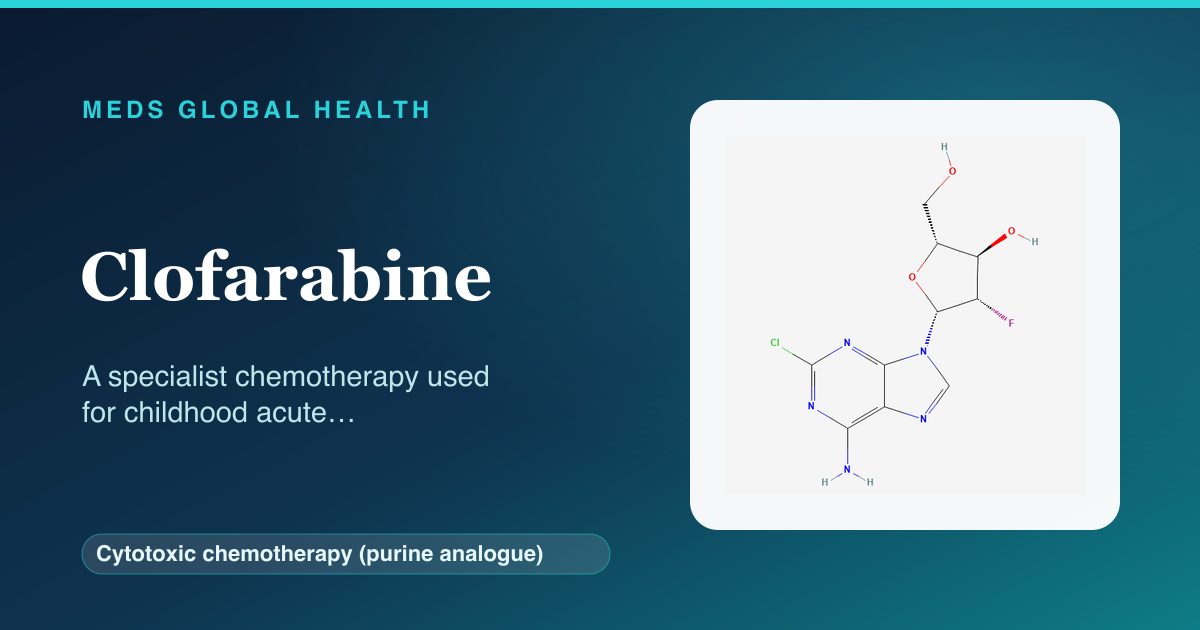
Clofarabine is a cytotoxic (cancer-killing) chemotherapy medicine of the purine-analogue type. It is used to treat acute lymphoblastic leukaemia (ALL) in children and young people whose leukaemia has relapsed or not responded after other treatments have been tried. It is given as an infusion (a drip) into a vein, in hospital, by a specialist cancer team. Because it is a powerful chemotherapy with serious possible effects, it is used only under close supervision with intensive monitoring and supportive care. It is a specialist medicine, not something taken at home.
How it works
Clofarabine gets taken up by leukaemia cells and interferes with the building and copying of their DNA, so the cancer cells cannot multiply and are pushed to die. Because it targets fast-dividing cells, it also affects healthy fast-dividing cells, especially the bone marrow that makes blood cells, which is why it strongly lowers blood counts. It can also trigger a powerful inflammatory response as large numbers of leukaemia cells break down, which is one reason a serious whole-body reaction with leaky blood vessels can occur. It is given in carefully planned courses with rest periods and a lot of supportive treatment.
Company & origin
A specialist chemotherapy used in the UK for children with acute lymphoblastic leukaemia whose disease has come back or not responded to other treatment.
Practical use
How to take Clofarabine
General, dose-free guidance — always follow your prescriber's and the leaflet's specific instructions.
- It is given as a drip into a vein in hospital by a specialist team, on a carefully planned schedule.
- Expect frequent blood tests and close monitoring of your child's blood counts, liver and kidneys throughout treatment.
- Seek urgent help for any fever, shivering or signs of infection, as a low white-cell count makes infection dangerous.
- Report straight away any rapid swelling, breathlessness, dizziness or feeling very unwell, which can signal a serious inflammatory reaction.
- Follow the team's advice on fluids, infection prevention and supportive medicines given alongside it.
Weighing it up
Advantages & disadvantages of Clofarabine
Advantages
- Offers a treatment option for childhood acute lymphoblastic leukaemia that has relapsed or not responded to other treatments.
- Works directly against the leukaemia cells by stopping them copying their DNA.
- Given in carefully planned courses with intensive specialist support.
Disadvantages
- Strongly suppresses the bone marrow, raising the risk of infection, anaemia and bleeding.
- Can cause a dangerous whole-body inflammatory reaction with leaky blood vessels.
- Can affect the liver and kidneys and requires hospital treatment with close monitoring.
Practical use
Good to know
The most important things to understand about clofarabine are its serious risks, all managed by the specialist team. It strongly suppresses the bone marrow, lowering white cells, red cells and platelets, which raises the risk of infection, anaemia and bleeding, so blood counts are watched closely and fever or signs of infection are treated as emergencies. It can cause a dangerous whole-body inflammatory reaction with leaky blood vessels (sometimes called systemic inflammatory response syndrome, SIRS, or capillary-leak syndrome), which can cause rapid swelling, breathing problems and a drop in blood pressure and needs urgent treatment. It can also affect the liver and kidneys, so these are monitored, and good hydration is used to protect them. Because it affects the immune system, infection prevention and prompt treatment of fever are vital. This is a hospital treatment with intensive support throughout.
Who should not take it / use with caution
- People who have had a serious allergic reaction to clofarabine should not receive it.
- It is used with great caution, or avoided, in people with significant liver or kidney problems.
- It is used only under specialist cancer care, with intensive monitoring and supportive treatment.
Monitoring
- Frequent blood counts to watch for low white cells, red cells and platelets.
- Close monitoring of liver and kidney function and of fluid balance and blood pressure.
- Watching for fever, infection and any signs of a serious inflammatory reaction.
Side effects
- A strong drop in blood counts, with infection, anaemia and bleeding or bruising.
- A serious whole-body inflammatory reaction with leaky blood vessels, swelling, breathing problems and low blood pressure.
- Effects on the liver and kidneys, shown in blood tests.
- Nausea, being sick, diarrhoea, fever, rash and tiredness.
Key interactions
- It is used with care alongside other medicines that affect the liver or kidneys, as these can add to the strain.
- Other medicines that lower blood counts or weaken the immune system can add to its effects.
- The team carefully reviews all medicines and supportive treatments given alongside it.
Available as: A solution given as a drip into a vein in hospital.
Answers
Clofarabine: frequently asked questions
What is clofarabine used for?
It is a chemotherapy used for children and young people with acute lymphoblastic leukaemia that has come back or not responded to at least two other treatments.
How is it given?
It is given as a drip into a vein in hospital by a specialist cancer team, with intensive monitoring and supportive care throughout.
Why are blood tests so frequent?
It strongly lowers blood counts, raising the risk of infection, anaemia and bleeding, so blood counts, liver and kidneys are checked closely.
What is the serious inflammatory reaction?
It can trigger a whole-body inflammatory reaction with leaky blood vessels, causing rapid swelling, breathing problems and low blood pressure, which needs urgent treatment.
What should we watch for at home?
Seek urgent help for any fever or signs of infection, and report rapid swelling, breathlessness or feeling very unwell straight away.
The wider class
About Cytotoxic chemotherapy (purine analogue)
Clofarabine belongs to the cytotoxic chemotherapy (purine analogue) class. For how the class as a whole works, its shared safety principles and monitoring, see the full guide.
Browse by body system
Authoritative sources
- BNF
- NICE CKS
Building a medicines information resource?
We create evidence-led, dose-free drug and formulary references for teams.