An antimetabolite chemotherapy medicine
Gemcitabine
A chemotherapy infusion, given under specialist care, for several cancers, generally well tolerated relative to some chemotherapy.
What is Gemcitabine?
Gemcitabine is a chemotherapy medicine given by drip (infusion) in hospital under cancer-team care, used for cancers of the pancreas, lung, bladder and breast, often combined with other treatments. Many people find it reasonably well tolerated compared with some other chemotherapy. A common effect is flu-like symptoms — mild fever, aches and tiredness — usually a few hours after treatment, which are often manageable. Like all chemotherapy it lowers blood counts and raises the risk of infection, so a fever (especially with feeling unwell) must be reported urgently, as it can be hard to tell apart from a serious infection.
Education and reference only. This is a plain-language guide to Gemcitabine — it deliberately contains no doses. Doses depend on the person, the brand and the reason for treatment, and belong with your prescriber. Always check the BNF, the product labelling (SmPC) and follow medical advice.
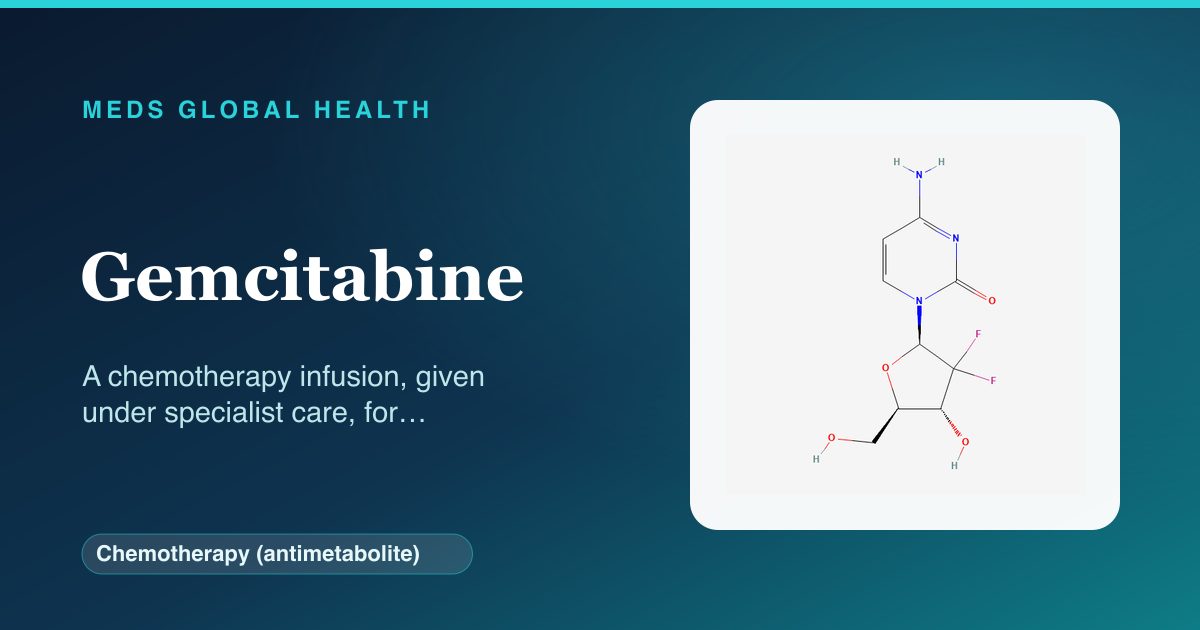
What it is
Gemcitabine is a cytotoxic chemotherapy medicine from the 'antimetabolite' family, given by drip in hospital for several cancers, including those of the pancreas, lung, bladder and breast. It is often used alone or combined with other chemotherapy, and is always prescribed and supervised by an oncology team. It is generally regarded as one of the better-tolerated chemotherapy medicines, though it still has important side effects to watch for. Treatment is given in cycles, usually on set days with recovery periods in between to let the body recover.
How it works
Gemcitabine slips into cancer cells and disguises itself as one of the building blocks needed to make DNA; once taken up, it blocks the cells from building and copying their DNA properly, so they cannot keep dividing and many die. Because it also affects healthy fast-dividing cells, particularly in the bone marrow, it can lower the blood counts. The flu-like symptoms some people get are thought to be a reaction to the treatment and usually settle, and can often be eased with simple measures.
Company & origin
Originated / developed by: Generic (originally Lilly).
A widely used chemotherapy medicine used in the UK, under specialist care, for pancreatic, lung, bladder and breast cancers.
Practical use
How to take Gemcitabine
General, dose-free guidance — always follow your prescriber's and the leaflet's specific instructions.
- It is given by drip in hospital by your cancer team, on a planned schedule of cycles with recovery periods.
- Expect possible flu-like symptoms a few hours after treatment, and ask your team how best to ease them.
- Always treat a fever as an emergency, even if it feels like the flu, and ring your team's emergency line.
- Report a rash, swelling of the ankles, or new breathlessness to your team promptly.
- Attend for your blood tests before treatment, as the dose may be adjusted depending on your blood counts.
Weighing it up
Advantages & disadvantages of Gemcitabine
Advantages
- Generally one of the better-tolerated chemotherapy medicines, which many people find reassuring.
- An effective, widely used treatment for several cancers, including pancreatic, lung, bladder and breast cancers.
- Can be used alone or combined with other treatments, allowing flexible treatment plans.
Disadvantages
- Commonly causes flu-like symptoms a few hours after treatment, which can be confused with infection.
- Like all chemotherapy, it lowers blood counts and raises the risk of serious infection.
- Can less commonly cause rash, ankle swelling, breathlessness or, rarely, kidney problems.
Practical use
Good to know
Gemcitabine is often better tolerated than some other chemotherapy medicines, which many people find reassuring, but it still needs care. A common and characteristic effect is flu-like symptoms — a mild fever, aches, headache and tiredness — usually within a few hours of the infusion; these often settle and can be eased with simple measures your team can advise on. Importantly, because it can lower your blood counts and raise infection risk, it can be hard to tell a harmless flu-like reaction from the fever of a serious infection, so always treat a temperature, shivering or feeling suddenly very unwell as a medical emergency (possible neutropenic sepsis) and ring your team's emergency line. Nausea is usually mild and anti-sickness medicines are given. It can cause a rash, mild swelling of the ankles, or breathlessness — report these. Rarely, it affects the kidneys, so kidney function is monitored. Pregnancy must be avoided and contraception used, fertility can be affected, and live vaccines avoided. It is natural to feel anxious about chemotherapy — your team would always rather you contacted them with a concern than waited.
Who should not take it / use with caution
- It is avoided in pregnancy and breastfeeding because it can harm a developing baby.
- It is used with caution, with dose adjustment, in people with significant kidney or liver problems.
- People with very low blood counts or active serious infection are assessed carefully before each cycle.
Monitoring
- Regular blood tests to check blood counts before each treatment, with the dose adjusted as needed.
- Checking kidney and liver function during treatment.
- Reviewing flu-like symptoms and any rash, swelling or breathlessness at each visit.
Side effects
- Flu-like symptoms (mild fever, aches, tiredness), mild nausea and low blood counts are common.
- Low blood counts raise the risk of infection, bruising, bleeding and anaemia — a fever or feeling very unwell needs urgent care.
- Less commonly, rash, ankle swelling or breathlessness, and rarely kidney problems.
Key interactions
- Live vaccines are avoided during treatment, as the weakened immune system cannot handle them safely.
- Other medicines that lower blood counts may add to the risk, so your team reviews these carefully.
- It can interact with other chemotherapy and radiotherapy timing, so all your treatment is coordinated by your team.
Available as: Infusion given in hospital; prescribed and supervised by a specialist.
Answers
Gemcitabine: frequently asked questions
Why do I feel like I have the flu after treatment?
Flu-like symptoms — a mild fever, aches and tiredness — a few hours after gemcitabine are common and usually settle; your team can advise simple measures to ease them.
How do I tell flu-like symptoms apart from an infection?
It can be hard to tell, so always treat a fever, shivering or feeling suddenly very unwell as an emergency and ring your team's emergency line, because it could be a serious infection (neutropenic sepsis).
Is gemcitabine easier to cope with than other chemotherapy?
Many people find it reasonably well tolerated compared with some other chemotherapy medicines, though it still lowers blood counts and needs careful monitoring.
Should I report a rash or swollen ankles?
Yes, tell your team about any rash, swelling of the ankles or new breathlessness, as these can occasionally occur and your team will want to check them.
Can I have it if I might become pregnant?
No. It can harm a developing baby, so pregnancy must be avoided and contraception used; discuss fertility and family plans with your team before starting.
The wider class
About Chemotherapy (antimetabolite)
Gemcitabine belongs to the chemotherapy (antimetabolite) class. For how the class as a whole works, its shared safety principles and monitoring, see the full guide.
Browse by body system
Authoritative sources
- BNF
- NICE CKS
Building a medicines information resource?
We create evidence-led, dose-free drug and formulary references for teams.